In an era defined by AI-generated imagery and the clinical perfection of smartphone photography, our team has observed a fascinating counter-movement sweeping across the United States. From the streets of Brooklyn to the beaches of California, Americans are craving something real. The “digital detox” movement isn’t just a buzzword anymore; it is a consumer shift toward tangible, imperfect, and one-of-a-kind memories.
We have spent the last few months testing the latest instant cameras to hit the market. We didn’t just look at spec sheets; we took these cameras to weddings, road trips, and late-night parties. We scoured TikTok trends to understand the “whimsy core” aesthetic driving Gen Z sales, and we deep-dived into the technical prowess of new lens systems for the serious photographers among us.
Our testing criteria were strict: we looked for reliability, build quality, ease of use, and that elusive “vibe” factor that makes instant photography special. We also paid close attention to the “cost per smile”—the value you get from every pack of film.
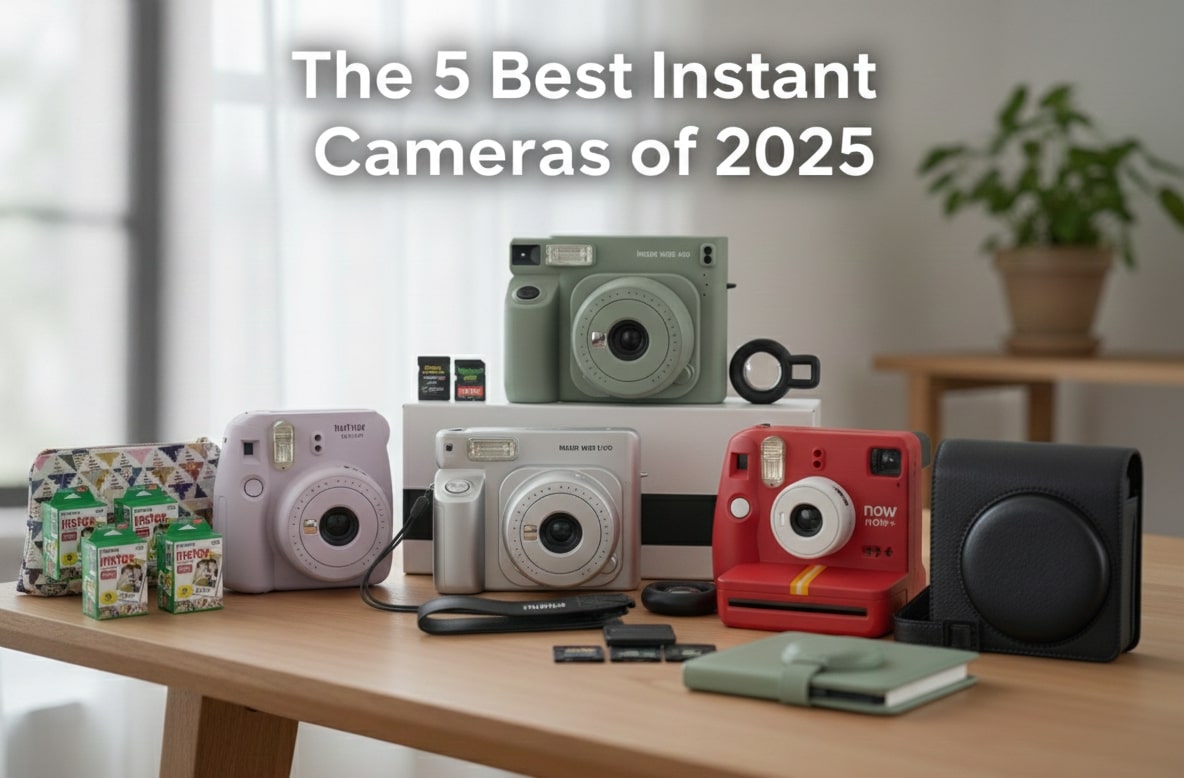
Below is our in-depth review of the 5 best instant cameras you can buy in 2025.
Advertising Disclosure
1. Fujifilm Instax Mini 12
Verdict: The Best Instant Camera for Beginners and Social Butterflies
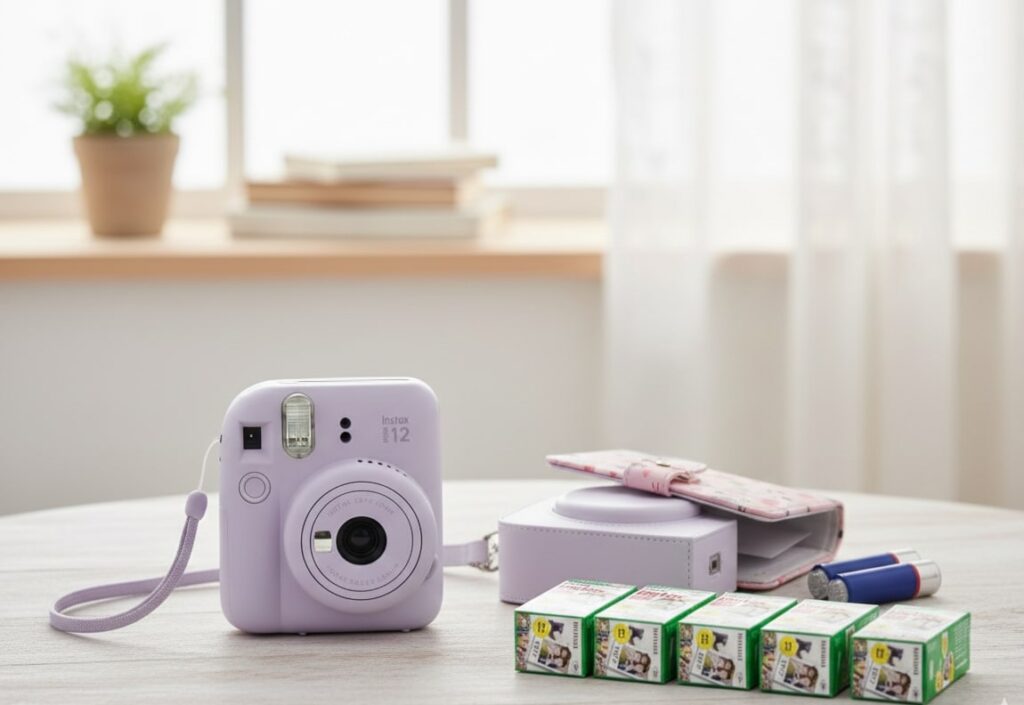
If there is one camera that defines the current instant photography landscape in the US, it is the Fujifilm Instax Mini 12. After putting this bubble-gum-colored device through its paces, our team unanimously agrees: it is the king of simplicity. It doesn’t try to be a professional tool; it tries to be fun, and it succeeds brilliantly.
The Design and Handling
The Mini 12 retains the “inflatable” aesthetic of its predecessors but refines it for better ergonomics. It feels sturdy in the hand—often described by our testers as “tank-like” despite its plastic construction. The most significant design change we appreciated was the power mechanism. Gone is the separate power button that was prone to accidental presses in backpacks. Instead, you simply twist the lens barrel to turn it on, and twist it again to enter “Close-Up Mode.” It is intuitive and tactile, a feature that kept us from wasting batteries during transport.
Our Shooting Experience
The standout feature during our testing was the parallax correction. On older models like the Mini 11, framing a selfie or a close-up shot was a guessing game; the viewfinder didn’t line up with the lens, often resulting in off-center photos. The Mini 12 physically adjusts the viewfinder when you twist into Close-Up mode, aligning your view with the lens. In our field tests, this meant that what we saw was exactly what we got on the print. For a point-and-shoot camera aimed at casual users, this is a game-changer.
The automatic exposure and flash control also performed admirably in most lighting conditions. However, our team noted one quirk: the flash is always on. You cannot turn it off. While this ensures you don’t end up with blurry, underexposed shots indoors, it can result in “blown-out” highlights if you are too close to your subject or shooting near a reflective surface. That said, this “direct flash” look is currently trending heavily on TikTok, feeding into the Y2K aesthetic that is so popular right now.
Who Is It For?
This is the camera we recommend to 90% of people. If you want to capture memories at a party, wedding, or brunch without fussing over settings, the Mini 12 is unbeatable. It uses the ubiquitous Instax Mini film, which is widely available and relatively affordable, making it a low-risk entry into the world of film.
2. Fujifilm Instax Mini Evo
Verdict: The Best Hybrid Camera for Travel and the Indecisive
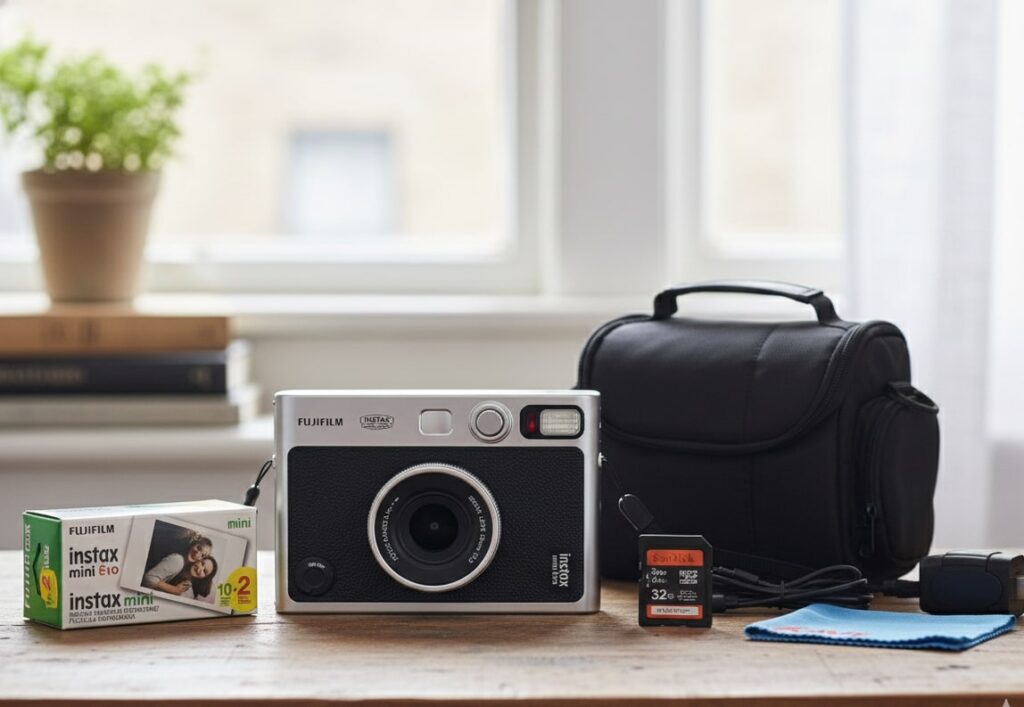
The Instax Mini Evo was a revelation during our review process. It solves the single biggest anxiety regarding instant photography: the fear of wasting expensive film on a bad shot. By combining a digital sensor with an analog printer, the Mini Evo essentially pays for itself over time by ensuring you only print the “keepers.”
The “Hybrid” Advantage
The Mini Evo creates a unique workflow that our team fell in love with. You shoot digitally, viewing your image on the rear LCD screen. You can apply 10 different lens effects (like Vignette or Fisheye) and 10 different film effects (like Vivid or Monochrome), giving you 100 possible creative combinations.
But the real magic happens when you decide to print. Fujifilm has included a “print lever” that mimics the film advance lever of old manual cameras. Pulling this lever to initiate the printing process is incredibly satisfying—a tactile bridge between the digital and analog worlds. During our travel tests, this feature was a favorite; it made printing feel like an event rather than just a function.
Performance and Value
One of the most heated debates in the camera world recently has been between the Mini Evo and the Leica Sofort 2. After extensive comparison, our team firmly stands behind the Mini Evo. The Sofort 2 is effectively a re-skinned Mini Evo with a significantly higher price tag for the brand name. Unless you absolutely need the red dot logo, the Mini Evo offers the exact same internal tech and print quality for a much more reasonable investment.
Battery life was another strong point. In our testing, we could go days without charging, easily hitting around 100 shots per charge. The ability to use it as a smartphone printer (sending photos from your phone to the camera to print) adds a layer of versatility that justifies its place in any traveler’s bag.
Who Is It For?
This is for the pragmatist who loves the idea of film but hates the cost of mistakes. It is also perfect for creative experimenters who want to layer effects and filters before committing to a print.
3. Polaroid I-2
Verdict: The Best Premium Camera for Professionals and Purists
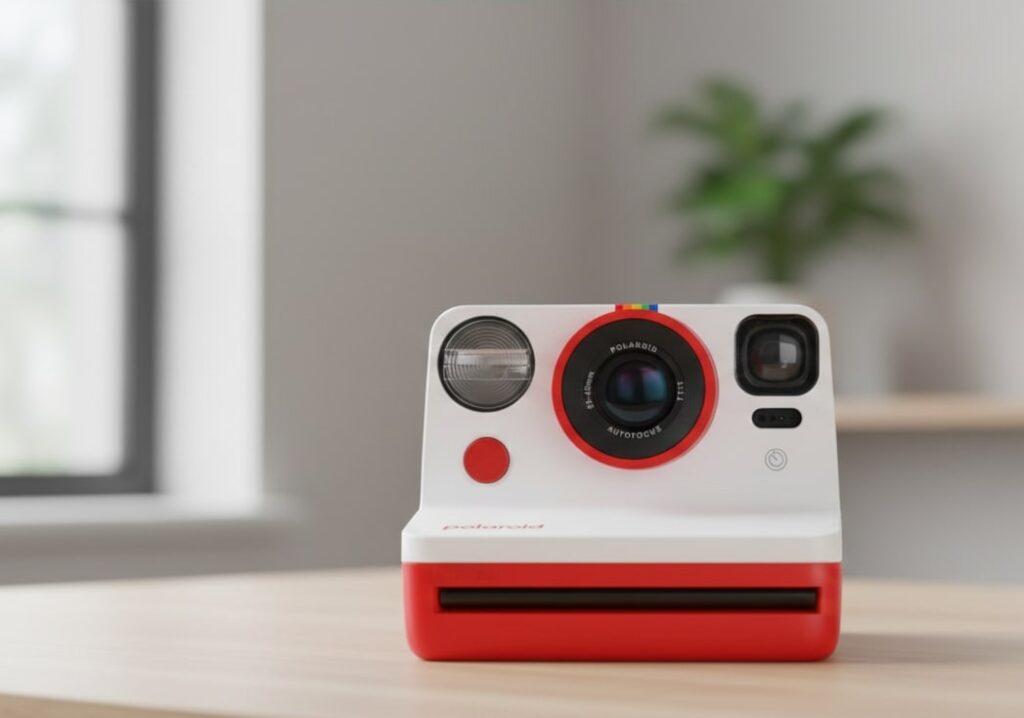
When we unboxed the Polaroid I-2, we knew we were dealing with something different. This is not a toy. It is a serious photographic tool designed to reclaim Polaroid’s legacy from the realm of novelty. For the photographer who wants full control over their image, the I-2 is without peer.
Engineering Mastery
The headline feature here is the lens. Our testing confirmed that this is the sharpest lens ever put on a consumer Polaroid camera. The 3-element autofocus system utilizes LiDAR technology—the same tech found in autonomous vehicles and high-end smartphones—to measure distance. In our low-light tests, where other instant cameras hunted for focus or failed completely, the I-2 locked onto subjects instantly and accurately.
We were also impressed by the manual controls. The I-2 offers full creative freedom with aperture priority, shutter priority, and fully manual modes, all viewable on a small but sharp external OLED display. Being able to stop down the aperture to f/64 for deep depth of field or open it up for portraits gave us a level of artistic expression usually reserved for digital DSLRs.
The Polaroid “Look”
While Instax film is known for its clinical consistency, Polaroid film is beloved for its dreamy, slightly unpredictable chemical aesthetic. The I-2 manages to tame this wildness slightly, producing images that are sharper and better exposed than the cheaper Polaroid Now+ models, while still retaining that soulful, vintage character.
However, our team noted that this performance comes with a learning curve. The I-2 requires you to understand light. It is not a “point-and-pray” camera; it rewards skill. We also found that to get the best results in cold weather, we had to be diligent about keeping the developing film warm (using the “armpit method” or a warm pocket), as Polaroid chemistry is sensitive to temperature.
Who Is It For?
The I-2 is for the artist. It is a significant financial investment, but for those who treat instant photography as a serious medium rather than a party favor, it is the ultimate machine.
4. Fujifilm Instax Mini 99
Verdict: The Best for Creative Analog Effects
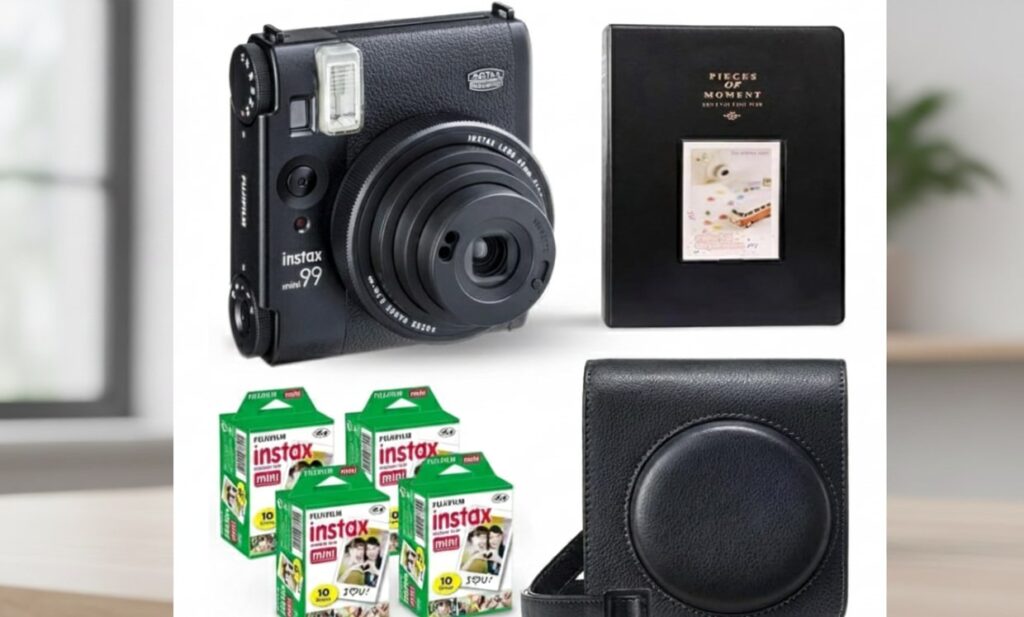
Released as a spiritual successor to the beloved Mini 90, the Instax Mini 99 captivated our team with its commitment to “real” analog effects. In a world of digital filters, the Mini 99 does everything physically, inside the camera body, and the results are stunning.
Analog Creativity
The standout feature of the Mini 99 is the Color Effect Dial. Inside the camera body, tiny LEDs flash different colors onto the film during exposure to create effects like “Warm Tone,” “Faded Green,” or “Light Leak”. During our testing, we found these effects to look far more organic and interesting than digital overlays. The “Light Leak” mode, in particular, became a team favorite for creating that serendipitous, vintage feel that usually only comes from broken cameras.
We also loved the Manual Vignette Switch. By physically narrowing the lens aperture blades, the camera darkens the corners of the frame to draw attention to the center subject. Combining a vignette with a warm color effect produced moody, cinematic portraits that looked like they were taken decades ago.
Handling and Features
The Mini 99 feels like a tool, not a toy. It features a rechargeable battery (NP-70S), which we found convenient compared to hunting for AA batteries. It also includes essential enthusiast features like Bulb mode (for long exposures/light painting) and Double Exposure. The zone focusing system requires you to guess the distance slightly (Macro, Standard, Landscape), but the tactile feedback of the lens ring makes this process engaging rather than tedious.
Who Is It For?
This is for the “vibes” chaser who wants distinct, artistic photos without going digital. If you find the Mini 12 too basic but the I-2 too complex (or expensive), the Mini 99 sits in that perfect “Goldilocks” zone of creative control and ease of use.
5. Fujifilm Instax Wide 400
Verdict: The Best for Parties, Weddings, and Landscapes
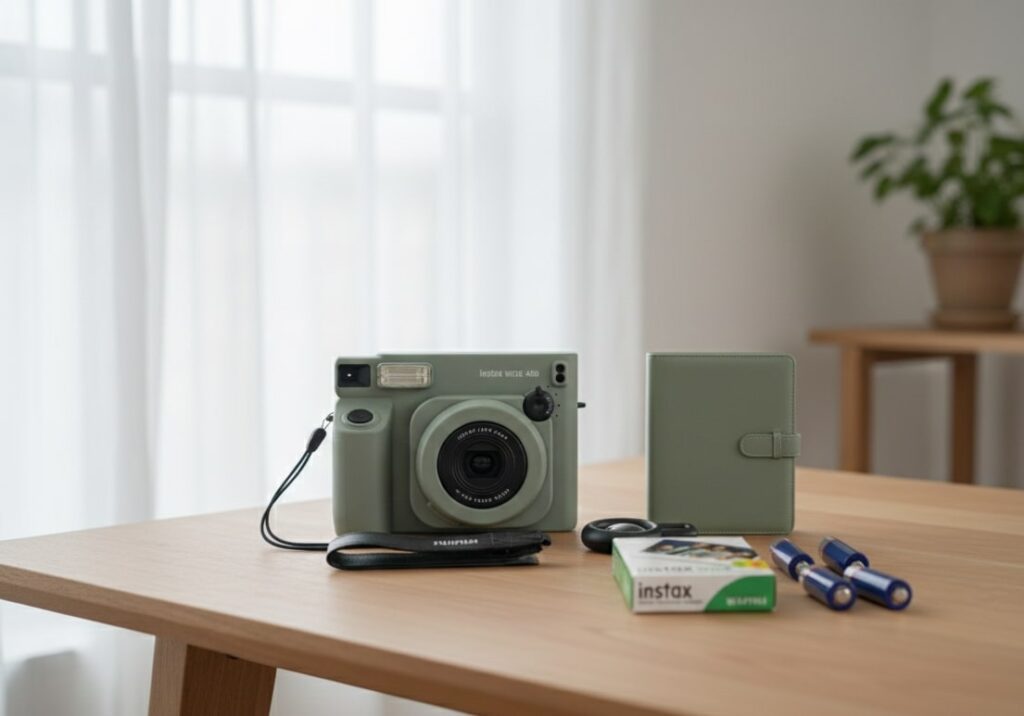
Sometimes, bigger really is better. The Instax Wide 400 addresses the main complaint about the Mini format: the photos are just too small. The Wide film is twice the size of Mini film, offering a panoramic canvas that captures context, scenery, and—most importantly—large groups of people.
Simplicity at Scale
The Wide 400 replaces the aging Wide 300, and our team appreciated the modernized design. It comes in a stylish Sage Green and, while still bulky (affectionately nicknamed “the toaster” by some), it handles better than its predecessor.
The killer feature for us was the self-timer mechanism. It is a purely analog dial that you twist to set a timer for 4, 6, 8, or 10 seconds. Coupled with the new “Camera Angle Adjustment” accessory (a simple but brilliant little wedge that lets you tilt the camera upward when placing it on a table), this camera became the hero of our group test events. We could set the camera down, twist the timer, run into the frame, and capture a group of 10 people without anyone being squeezed out.
Performance
The Wide 400 is a straightforward point-and-shoot. It lacks the manual bells and whistles of the I-2 or the effects of the Mini 99, but it excels at reliability. The exposure is generally spot-on, and the flash is powerful enough to light up a small group. We found it to be the ultimate “event” camera. Leaving this on a table at a wedding reception guarantees you’ll wake up to a pile of hilarious, well-framed memories.
Who Is It For?
This is for the social historian. If you want to document family gatherings, road trip landscapes, or events where you want to see the whole scene, the Wide format is superior, and the 400 is the best vessel for it.
Comparison and Buying Advice
Choosing between these five excellent cameras comes down to what you value most in your photography experience.
| Target Audience | Winner | Why it wins |
|---|---|---|
| The Pure “TikTok Aesthetic” | Fujifilm Instax Mini 12 | Creates that high-contrast, direct-flash look (“Wabi-Sabi” style). Durable, simple, and film is easy to find. |
| The Value-Conscious | Fujifilm Instax Mini Evo | Unrivaled hybrid. Select which photos to print (saves money on blurs). Bridges the gap between smartphone & physical world. |
| The Artist | Polaroid I-2 | Highest quality ceiling. Offers sharpness, depth of field, and specific chemical nostalgia that Instax cannot reach. |
| The Tactile Creator | Fujifilm Instax Mini 99 | A unique middle ground. Offers physical controls and gorgeous color effects without the high cost of Polaroid film. |
| The Socialite | Fujifilm Instax Wide 400 | Best for scale. Ensures no one gets left out of the frame; captures the moment rather than just a face. |
A Note on Film
When budgeting for these cameras, our team advises considering the ongoing cost. Instax Mini film is generally the most budget-friendly and widely available. Instax Wide film costs slightly more but offers double the image area. Polaroid i-Type film (for the I-2) is a premium product for a premium look; it is an investment in art rather than just a snapshot.
In 2025, the desire to hold a physical photograph is stronger than ever. Whether you choose the simplicity of the Mini 12 or the precision of the I-2, any of these cameras will help you step away from the screen and capture a moment that you can actually hold.
Summary of Our Top Picks
The Best Overall for Most People: Fujifilm Instax Mini 12 We chose this as our top pick because it masters the basics. The parallax correction solves the biggest frustration beginners face, and the simple twist-lens operation makes it ready to shoot in seconds. It is the definition of “point and shoot” joy.
The Best Hybrid Digital/Analog: Fujifilm Instax Mini Evo We chose this for its incredible versatility. The ability to print from your phone and save digital copies of your Instax shots makes it the most practical camera on this list. The print lever adds a satisfying tactile element that we simply loved.
The Best Premium Professional Camera: Polaroid I-2 We chose this for its uncompromising quality. With LiDAR autofocus and crisp glass optics, it produces the best-looking instant photos we have ever seen. It reclaims the “professional” status for the Polaroid brand.
The Best for Creative Experimentation: Fujifilm Instax Mini 99 We chose this for its unique internal LED color effects and manual vignette control. It allows for artistic expression that feels organic and analog, rather than digital and processed.
The Best for Groups and Events: Fujifilm Instax Wide 400 We chose this because of the Wide format’s ability to capture context. The new self-timer and angle adjustment accessory make it the undisputed champion of group selfies and party photography.
YOU MIGHT ALSO LIKE: Hands-On Review DSLRs in 2025, Apple AirTag Review [2025]