
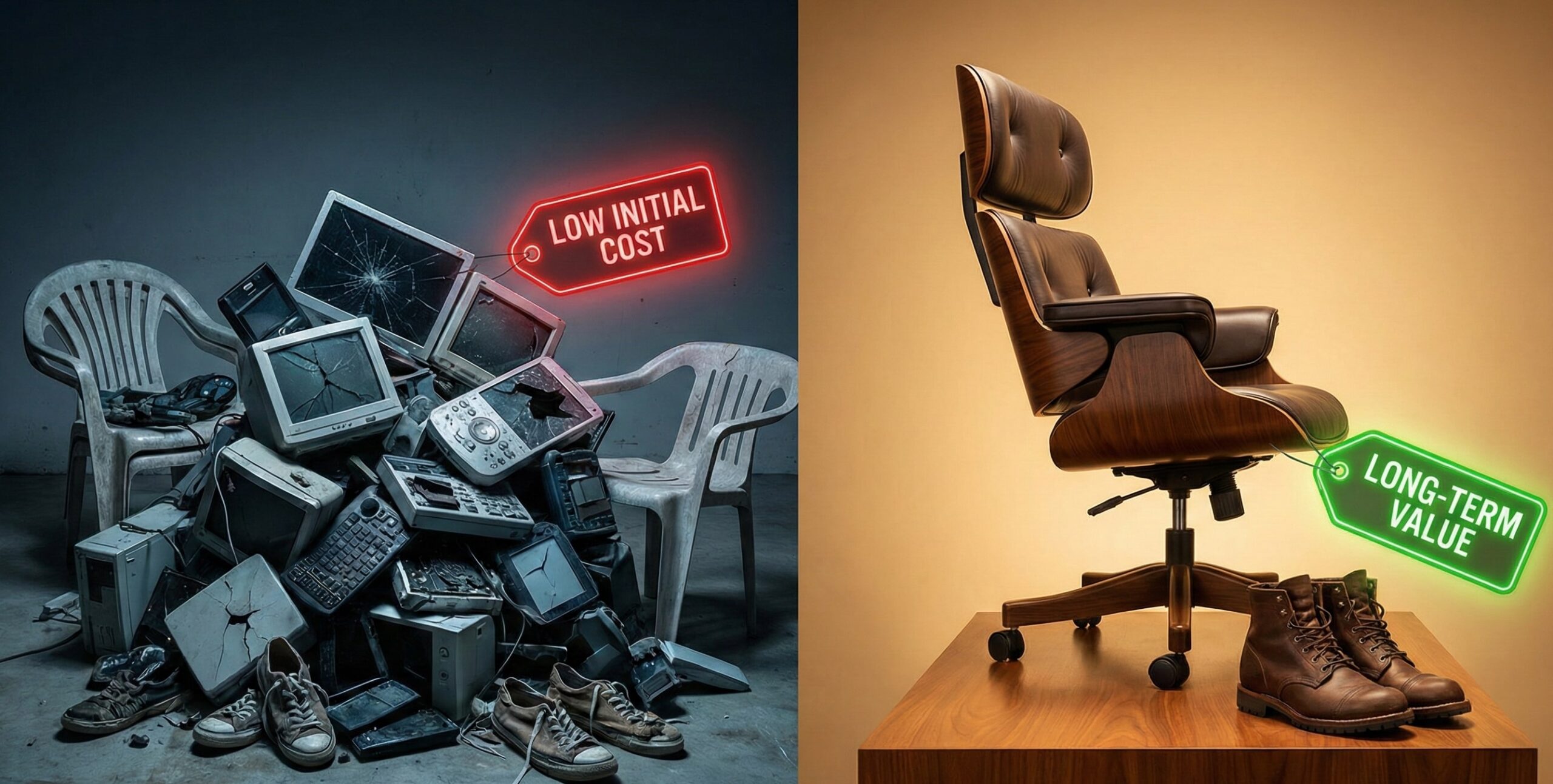
Have you ever bought a gadget just because it was on clearance, only to toss it in the trash six months later? That feeling of regret is what we call the “Buy cheap, buy twice” trap. The real pain isn’t just the lost cash; it’s the frustration of the product failing exactly when you need it most, plus the wasted time spent searching for a replacement.
At ReviewByBuyer, we don’t judge products by their price tags. We judge them by their Value Index. To do that, our expert team uses a simple yet powerful mathematical tool: The Cost Per Use (CPU) Formula.
1. What is the Cost Per Use (CPU) Formula?
Instead of looking at how much you pay at the register, look at how much you pay for every time you actually use the item.

If an item has a high upfront cost but you use it daily for years, its CPU will be significantly lower than a “cheap” item that breaks quickly.
2. Nick Anderson’s Case Study: The Office Chair Battle
When we set up the ReviewByBuyer specialist office, we had a choice to make regarding our seating.
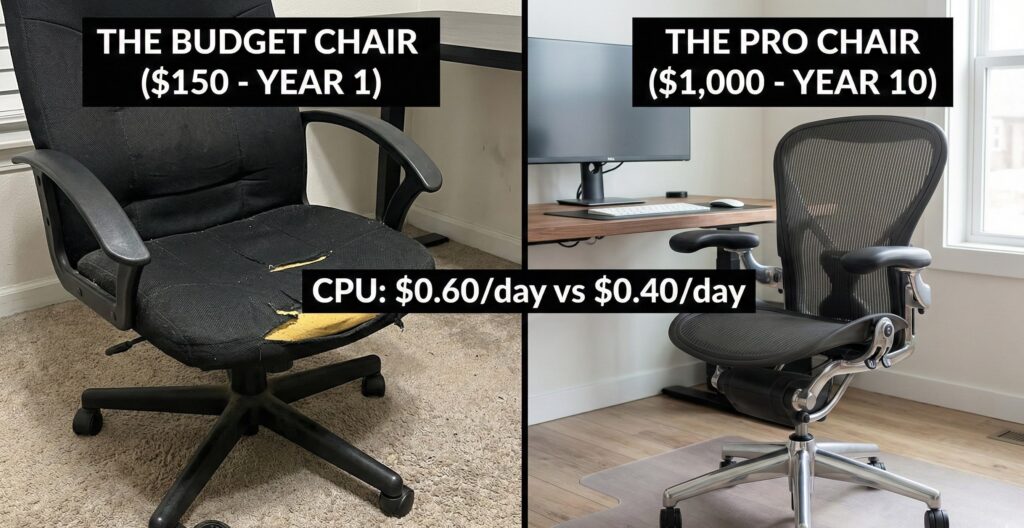
- Option A (The Budget Choice): A generic office chair for $150.
- The Experience: After 1 year, the foam flattened, the plastic frame started squeaking, and I was spending money on back-pain patches.
- Lifespan: 1 year (approx. 250 workdays).
- CPU: $150 / 250 = $0.60 per day.
- Option B (The Pro Choice): A high-end ergonomic chair (like a Herman Miller) for $1,000.
- The Experience: Incredible comfort, perfect spinal support, and a 12-year warranty.
- Lifespan: At least 10 years (approx. 2,500 workdays).
- CPU: $1,000 / 2,500 = $0.40 per day.
Nick’s Verdict: The $1,000 chair was actually 33% cheaper than the $150 chair, not to mention the thousands of dollars saved in future physical therapy for my spine.
3. When Should You Apply the CPU Formula?
Our expert team follows a golden rule: Invest heavily in anything that separates you from the ground.
- Mattresses: You spend 1/3 of your life sleeping. A $2,000 mattress that lasts 10 years costs you only $0.54 per night for quality sleep.
- Footwear: A $150 pair of high-quality running shoes that protect your knees is a far better investment than a $40 fashion sneaker with zero support.
- Work Tools (Laptops/Chairs): The items you touch for 8 hours a day.
4. The “Vimes Boots Theory” of Economics
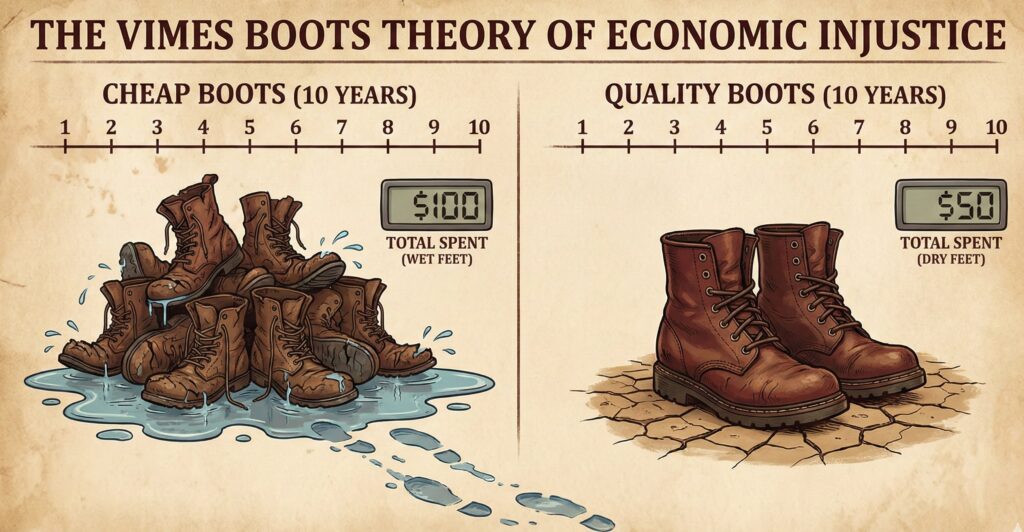
At ReviewByBuyer, we often cite the famous logic of author Terry Pratchett: “A wealthy person can buy a $50 pair of boots that lasts 10 years. A poor person can only afford $10 boots and has to replace them every year. After 10 years, the poor person has spent $100 and still has wet feet, while the wealthy person spent $50 and has dry feet.”
Our mission is to help you break that cycle by identifying the products that are truly “Buy Once, Cry Once” investments.
Final Thoughts from ReviewByBuyer
Don’t let the sticker price fool you. A real bargain is a product that still serves you well five years from now. At ReviewByBuyer, we are committed to including this CPU perspective in all our upcoming reviews so you can shop with the confidence that you are saving money even when you are spending it.