
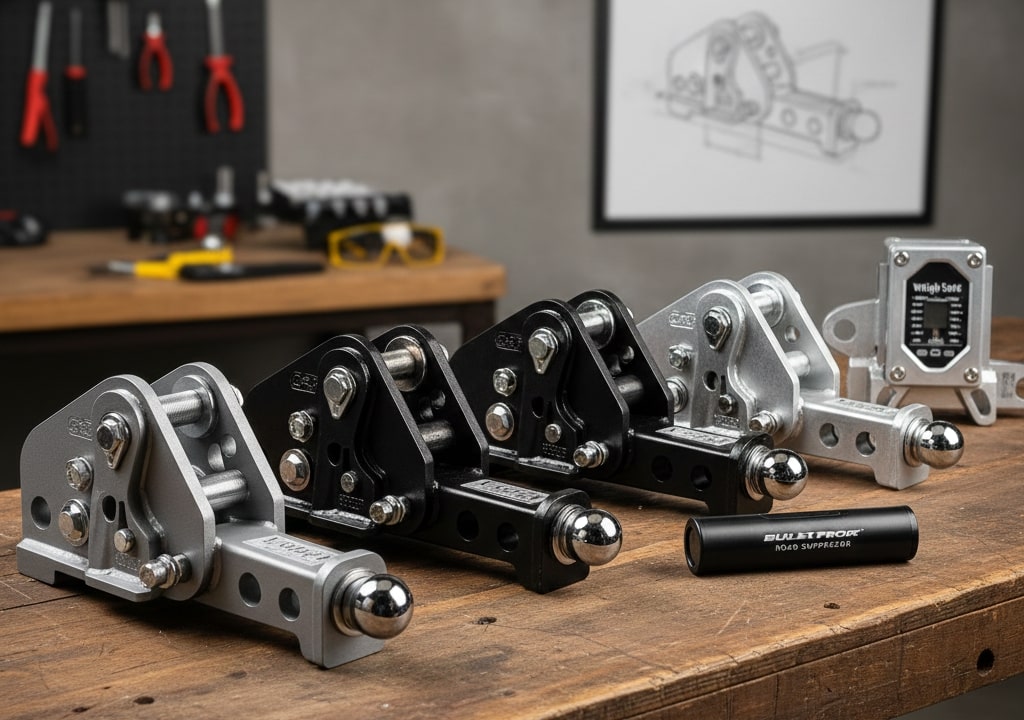
If you own a heavy-duty pickup truck—whether it’s a Ford F-250 Super Duty, a Ram 2500 Cummins, or a Silverado 2500HD—and especially if you have modified its suspension with a lift kit, you have likely realized that a standard fixed ball mount is useless. You need an adjustable drop hitch.
However, the market has become a minefield. It is flooded with brands promising “military-grade” durability and “aircraft-quality” materials. After logging thousands of miles towing everything from enclosed car haulers and heavy dump trailers to wakeboard boats, and after putting the industry’s top contenders through the wringer, I am here to share the truth.
This is not a spec-sheet comparison. This is a deep dive into the metallurgy, physics, and day-to-day reality of living with the top 7 adjustable trailer hitches on the US market today.
Advertising Disclosure
THE PHYSICS OF FAILURE (Why Your Hitch Matters)
Before we discuss brands, we must discuss physics. Most catastrophic hitch failures happen not because the steel snapped under a direct pull, but because the driver didn’t understand Geometry and Dynamics.
1. The “Lever Arm” Effect
This is the single most critical concept for lifted truck owners. When you install a drop hitch to compensate for a 6-inch or 8-inch lift, you are not just lowering the ball; you are creating a massive lever arm.
- The Physics: Torque (tau) equals Force (F) multiplied by Distance (d).
- The Reality: When you accelerate, brake, or hit a pothole, the force exerted by the trailer is multiplied by the length of that drop shank. A 12-inch drop hitch exerts significantly more torque on your truck’s receiver tube than a standard 2-inch drop.
- The Danger: Cheap, hollow-tube hitches often fail here. They may handle the gross trailer weight (GTW) pulling forward, but they cannot handle the torsional stress of the lever arm. This creates metal fatigue, leading to bending or, in worst-case scenarios, shearing of the receiver pin. This is why, for this review, we heavily favor solid steel shanks.
2. Metallurgy: The Steel vs. Aluminum War
There is a fierce debate in the industry regarding materials.
- Steel (The Old Guard): Steel has an “infinite fatigue limit.” As long as the stress remains below a certain threshold, steel can flex and return to its original shape indefinitely. It is ductile, meaning it will likely bend before it breaks, giving you a visual warning. The downside? It is heavy and it rusts.
- Aluminum (The Challenger): 6061-T6 Billet Aluminum is incredible. It has a high strength-to-weight ratio and is naturally corrosion-resistant. However, aluminum has no fatigue limit. Every cycle of stress contributes to eventual fatigue. While modern engineering has made aluminum hitches incredibly safe for standard usage, for “extreme duty” applications (20,000+ lbs), steel remains the king of longevity.
- Galvanic Corrosion: This is a silent killer. If you leave an aluminum hitch inside a steel receiver tube through a salty winter, the two metals will react and fuse together. We have seen owners forced to use sledgehammers or even cut their hitches off because they neglected this interaction.
3. Dynamic Shock (The “Chucking” Phenomenon)
Towing isn’t static. It’s a violent environment. “Chucking” is the sensation of the trailer pushing and pulling the truck as you drive over expansion joints. A solid hitch transmits 100% of this energy into the frame of your truck—and your spine. This brings us to the rise of Shock-Absorbing Hitches, which use torsion cords or polyurethane to isolate these forces.
THE “TESTED” REVIEWS
We selected the seven most prominent models on the market and evaluated them based on build quality, ease of adjustment, ride comfort, and long-term durability.
1. Gen-Y Mega Duty Adjustable Drop Hitch
The Industrial Titan
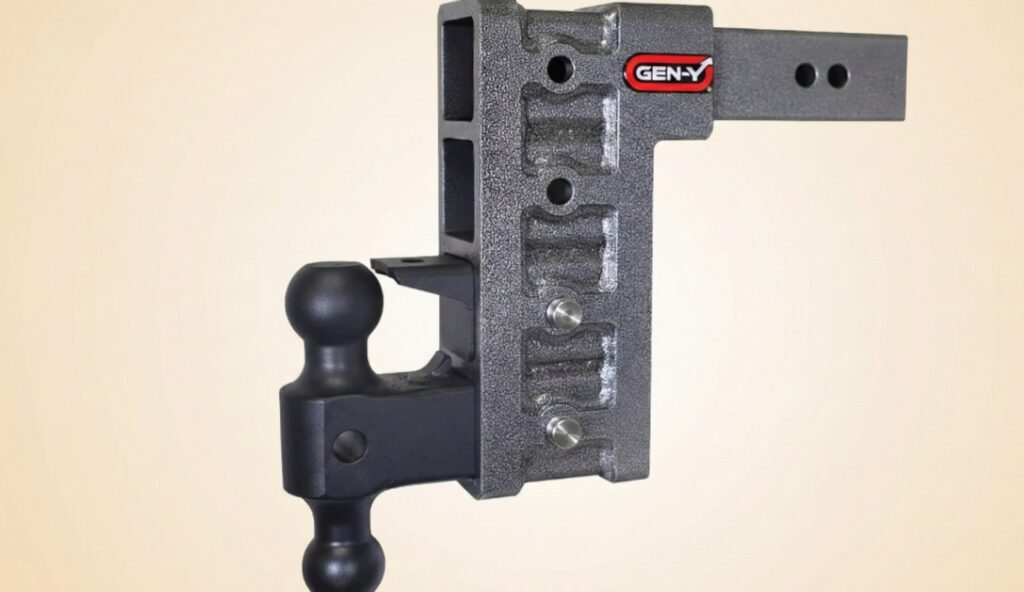
If you walk onto a commercial job site or a hotshot trucking lot, this is the hitch you will see. The Gen-Y Mega Duty creates an immediate impression: it looks like it was built for a tank.
The Design:
Unlike competitors that use a sliding channel, Gen-Y uses a “ladder” design with multiple stacked receiver tubes welded into a solid unit. This is brilliant for rigidity. There are no moving parts to rattle or wear out in the main shank. It allows you to use the hitch for multiple purposes simultaneously—for example, you can have the ball mount in the bottom slot and a bike rack or step in the top slot.
The Experience:
Towing with the Mega Duty feels incredibly secure. There is absolutely no flex. The “Versa-Ball” mount is a highlight; it includes 2″ and 2-5/16″ balls, and remarkably, a port for a Pintle Lock. If you tow heavy equipment trailers with a lunette ring, this is the only hitch you should consider. You simply insert the pintle lock pin, and you are ready to go.
The Drawbacks:
It is heavy. The 21,000 lb version is a dense block of steel that is difficult to remove alone. Also, because it is a rigid connection, you feel every bump the trailer hits. The powder coat is durable (usually a silver-vein finish), but once it chips, the steel underneath will rust if not touched up.
2. Gen-Y Boss Torsion-Flex Hitch
The Smooth Operator
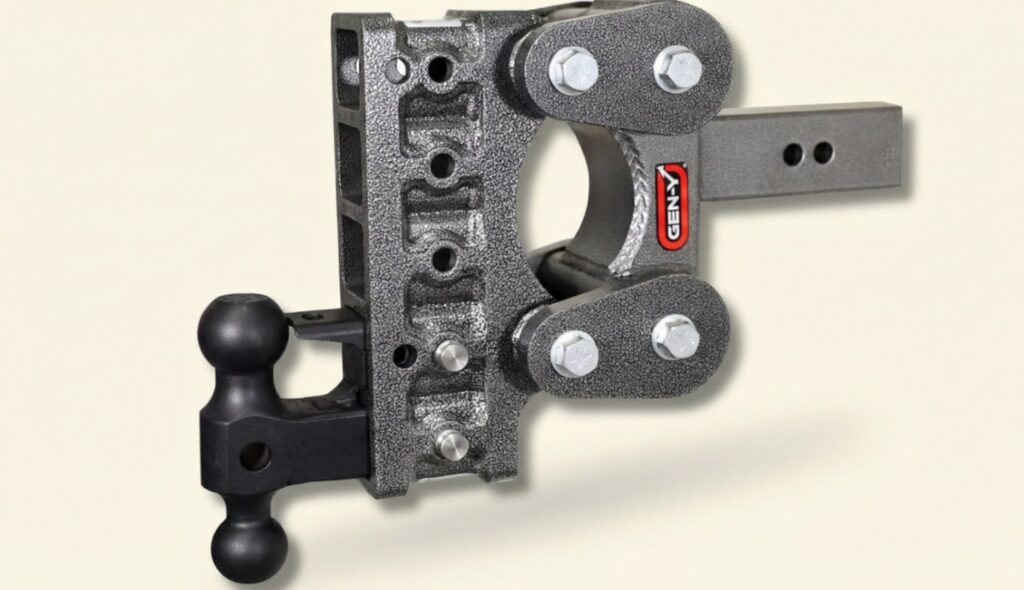
Gen-Y took the Mega Duty structure and integrated their patented Torsion-Flex technology. This splits the hitch into two parts connected by internal rubber torsion cords.
The Experience:
The difference in ride quality is startling. We tested this with a 14,000 lb dump trailer on a concrete highway. With a standard hitch, the expansion joints caused significant “kidney-punching” feedback. With the Boss Torsion-Flex, that feedback was reduced by at least 80-90%. The hitch acts as a suspension system between the truck and trailer. It also includes a mechanical tongue weight scale (on some models) built into the torsion pivot, giving you a visual indicator of your load.
The Drawbacks:
It is massive. The unit extends significantly far from the bumper, which increases the lever arm effect (though the hitch is built to handle it). It is also exceptionally heavy; do not plan on taking this off your truck often. It is an investment for those who tow long distances and value their comfort and vehicle longevity.
3. BulletProof Hitches Extreme Duty
The “Overkill” Option
BulletProof Hitches lives up to its name. Their philosophy is simple: pure strength through superior materials and geometry.
The Design:
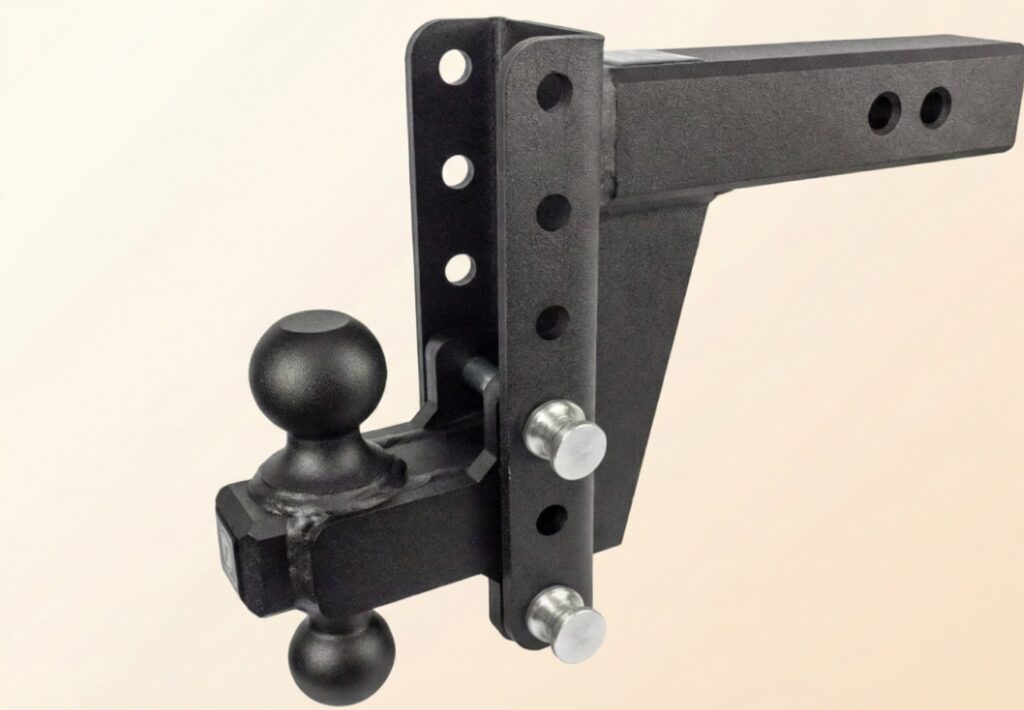
The shank is solid steel—not tubing. The edges are CNC chamfered for a smooth slide into the receiver. The adjustment channel is a heavy steel C-channel reinforced with a massive gusset plate. The finish is a signature textured black powder coat that we found to be incredibly resistant to rock chips and scratches.
The Experience:
This hitch exudes confidence. When you lock the pins in, it feels like a permanent part of the frame. For lifted trucks requiring a 10-inch, 12-inch, or even 16-inch drop, this is the gold standard. The rigidity of the solid shank eliminates the “noodle” feeling you get with cheaper deep-drop hitches. We also appreciate the simplicity; there are no springs or airbags to fail. It is just brute strength rated for up to 36,000 lbs (depending on configuration).
The Drawbacks:
Adjusting the ball height requires pulling two large pins. It’s a bit slower than some rapid-adjust systems, but it’s a fair trade-off for the stability. Like the Gen-Y, it transmits road shock directly to the truck.
4. BulletProof Road Suppressor
The Hybrid Solution
Recognizing the demand for smoother towing without the bulk of a full torsion hitch, BulletProof introduced the Road Suppressor.

The Design:
They took their standard solid-steel slider and integrated a polyurethane bushing system into the ball mount itself. The internal ball structure “floats” within the housing, isolated by the poly material.
The Experience:
This is a clever middle ground. It doesn’t offer the massive travel and damping of the Gen-Y Torsion-Flex, but it successfully takes the “edge” off. It dampens the high-frequency vibrations and the sharp metal-on-metal clunking during acceleration and braking. It’s perfect for boat owners or RVers who want the BulletProof durability but want to protect their delicate cargo from vibration.
The Drawbacks:
The damping capacity is limited by the size of the poly bushing. It won’t erase massive potholes, but it makes the ride noticeably more refined.
5. Curt Rebellion XD
The Modern Tech Choice
Curt approaches the problem with a futuristic design. The Rebellion XD looks like a component from a sci-fi rover.
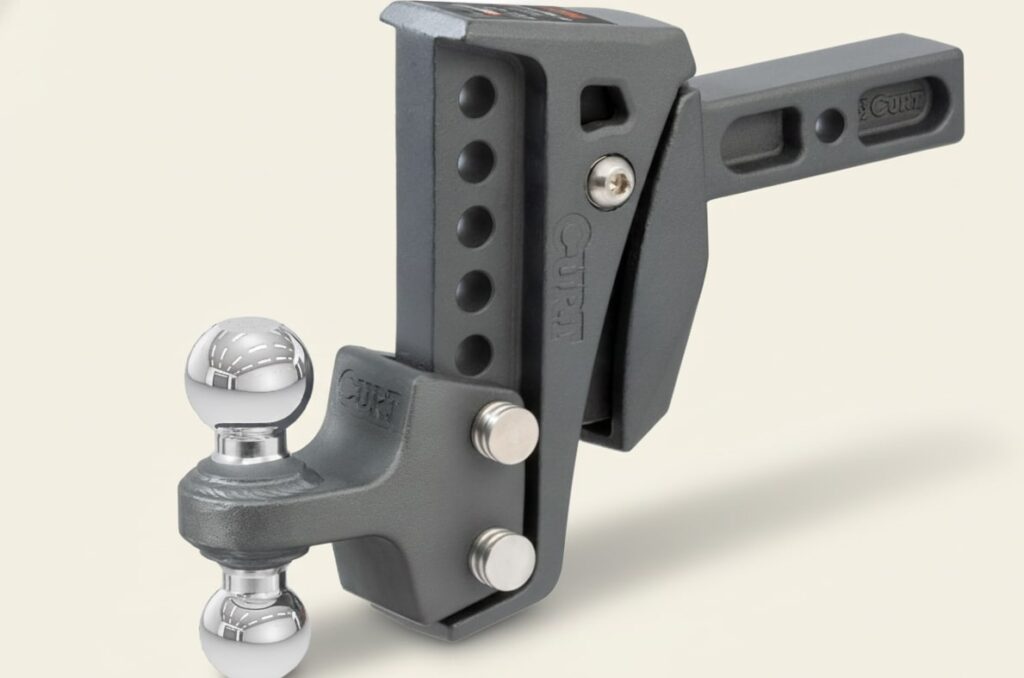
The Design:
It uses ShockDrop technology, essentially a cushioned isolator core made of polyurethane placed between the vertical shank and the ball mount assembly. It is made of cast steel rather than welded plate steel, giving it a sleek, sculpted look.
The Experience:
We were impressed by the Rebellion XD’s responsiveness. Because the entire ball mount head moves on the cushion, it dampens both vertical and horizontal forces effectively. It is virtually maintenance-free (no grease zerks or airbags). It feels lighter and easier to handle than the Gen-Y Boss, making it a great option for weekend warriors who want shock absorption without the industrial bulk.
The Drawbacks:
In extreme cold temperatures, polyurethane can stiffen, potentially reducing the damping effect slightly. The “cast” look is polarizing—some love it, some prefer the welded industrial look.
6. Weigh Safe Aluminum Drop Hitch (With Built-in Gauge)
The Data Nerd’s Dream
Weigh Safe changed the industry by integrating a hydraulic scale directly into the hitch.
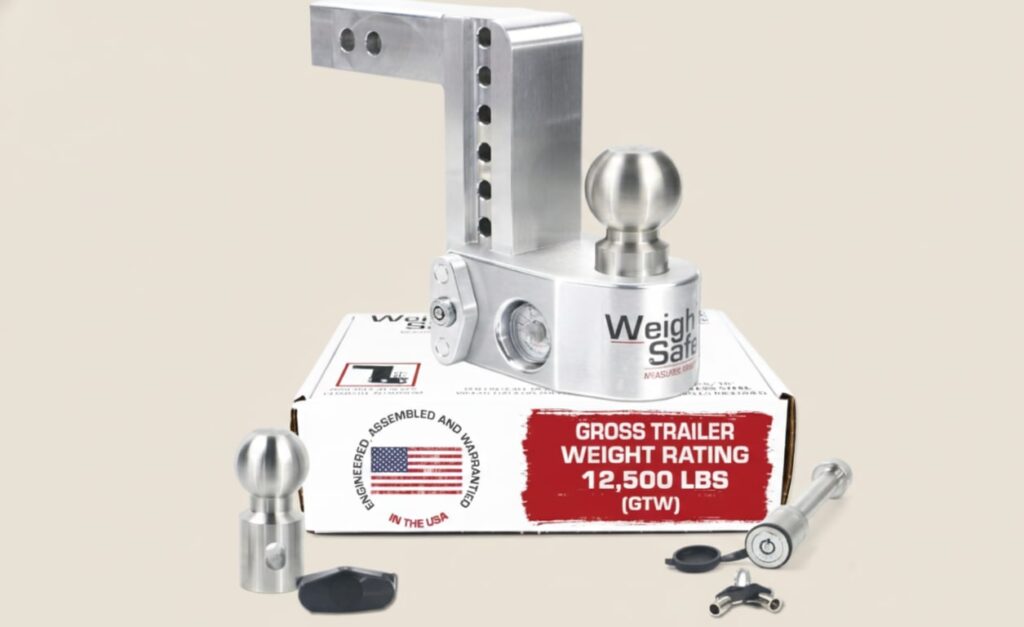
The Design:
Machined from a solid block of 6061-T6 Aluminum. It is a piece of art—shiny, precise, and beautiful. The standout feature is the gauge on the side that tells you your tongue weight in real-time as you lower the trailer.
The Experience:
For safety, this is unparalleled. Knowing your tongue weight (which should be 10-15% of GTW) prevents sway before it starts. The aluminum construction makes it incredibly light compared to the steel giants above. You can easily remove it and stow it in the cab. The adjustment mechanism is smooth, and the stainless steel balls are high quality.
The Drawbacks:
Aluminum requires care. It will not rust, but it will oxidize and lose its shine if exposed to road salt without polishing. The hydraulic gauge is a mechanical part with O-rings; while durable, we have seen long-term reports of seals needing maintenance after a few years of harsh weather exposure. You must also be vigilant about not leaving it in a steel receiver to prevent galvanic corrosion (seizing).
7. Weigh Safe 180 Hitch
The Quick-Change Artist
This is the non-gauge version, available in both aluminum and steel variants.
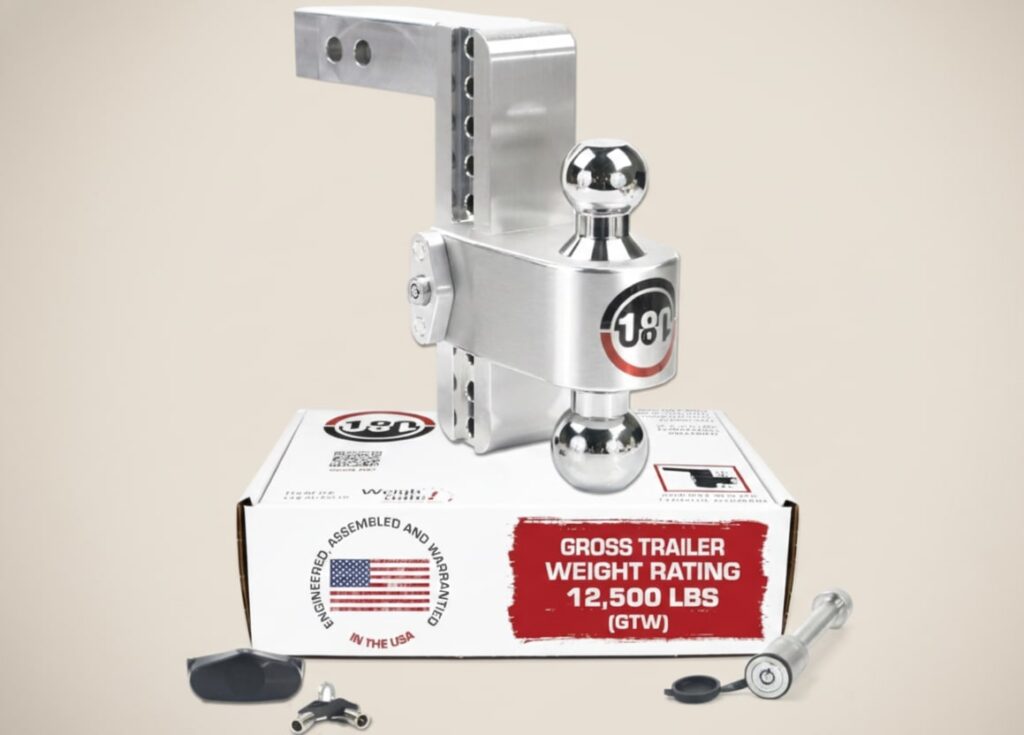
The Design:
The “180” refers to the slider mechanism. You can pull the pin and rotate the slider 180 degrees to switch from a 2″ ball to a 2-5/16″ ball in literally two seconds.
The Experience:
This is the most user-friendly hitch in the group. The mechanism is buttery smooth. If you own a landscaping company or run a rental yard where you are constantly switching between trailer types, this speed is invaluable. The steel version (often black powder coated or chrome plated) solves the galvanic corrosion anxiety of the aluminum version while keeping the smart design.
The Drawbacks:
It lacks the shock absorption of Gen-Y or Curt and the massive overload safety factor of BulletProof. It is a “standard duty” to “heavy duty” hitch, perfect for most, but not for the extreme hauler.
CRITICAL BUYING ADVICE (Read Before You Buy)
1. The “Slop” is Real
All adjustable hitches, by design, have moving parts. This means tolerance gaps. Without intervention, they will rattle.
- The Fix: Do not buy an adjustable hitch without also buying a Hitch Clamp or Anti-Rattle Kit. This simple U-bolt device tightens the hitch to the receiver, eliminating noise and reducing shock load on the pin.
2. Lock It Up
These hitches are premium items. They are prime targets for theft.
- The Fix: Invest in high-quality, stainless steel locking pins. Avoid the cheap locks found at big-box stores; their tumblers often seize up after one winter of road salt, forcing you to cut the lock off with an angle grinder. Look for locks with weather caps and tubular keys.
3. The Warranty Trap
Be aware of the Magnuson-Moss Warranty Act. Some RV chassis manufacturers (like Lippert) have historically tried to deny frame warranties if you use certain aftermarket pin boxes or hitches (like goose-neck adapters on 5th wheels).
- The Reality: While bumper-pull hitches (like the ones reviewed here) rarely cause warranty disputes, using rigid, heavy-duty hitches on lightweight frames can transmit excess stress. Always match the hitch class to your truck and your trailer frame’s capability.
4. Maintenance is Not Optional
- For Steel: Keep the powder coat clean. Touch up chips with paint immediately. Grease the pins annually.
- For Aluminum: Remove the hitch from the receiver when not in use during winter. If you must leave it in, wrap the shank in duct tape or use a plastic isolator sheet to prevent metal-to-metal contact with the steel receiver.
THE VERDICT
After assessing the engineering, the tow feel, and the durability, here are our top recommendations based on your specific profile:
Best for Heavy Duty & Lifted Trucks: BulletProof Hitches Extreme Duty
If you have a lifted F-250 or 350 and tow heavy equipment, this is the one. The solid steel shank eliminates flex, and the construction is bombproof. It is the safest way to drop a ball 12+ inches without compromising structural integrity.
Best for Ride Comfort & Long Hauls: Gen-Y Boss Torsion-Flex
If you tow an RV, horse trailer, or sensitive cargo across the country, your back (and your cargo) will thank you. The ability to isolate the truck from the trailer’s jarring movements makes the high weight and bulk completely worth it.
Best for Safety & Weekend Warriors: Weigh Safe Aluminum Drop Hitch
For the average boat owner or camper who wants to ensure they are loaded safely, the built-in scale is a game-changer. It is light enough to handle easily, looks fantastic on a polished truck, and provides critical safety data every time you hook up.
Best Value & Versatility: Curt Rebellion XD
This hits the sweet spot. It offers legitimate shock absorption technology and a modern design without the massive weight or price tag of the Gen-Y Boss. It is a fantastic “set it and forget it” option for daily drivers.
Disclaimer: Towing involves serious forces and safety risks. Always verify your vehicle’s Gross Vehicle Weight Rating (GVWR) and Towing Capacity in your owner’s manual. The hitch is only one part of the equation; tires, brakes, and driver skill are equally important.
YOU MIGHT ALSO LIKE: 10 Best Air Conditioners for RV, 10 Best Car Scanner
Frequently Asked Questions (FAQ)
Is it illegal to drive with a trailer hitch on when not towing in the USA?
Aluminum vs. Steel Hitches: Which is better for the Rust Belt region?
How do I calculate the correct drop hitch size for a lifted truck?
Measure the difference between the receiver and coupler. Park on level ground, measure the distance from the ground to the top of your truck’s receiver tube, and subtract the distance from the ground to the bottom of the trailer coupler. For lifted trucks common in the Southern US, you typically need a 6-inch to 10-inch drop to tow a standard trailer levelly.