
Why I Finally Swapped My Family’s Dash Cam After 1,200 Miles of Testing
Three weeks ago, I was driving my 10-year-old son, Leo, to his travel baseball game. We were cruising down the I-95 when a semi-truck in the next lane blew a tire. Chunks of heavy rubber flew everywhere. One hit my hood, narrowly missing the windshield.
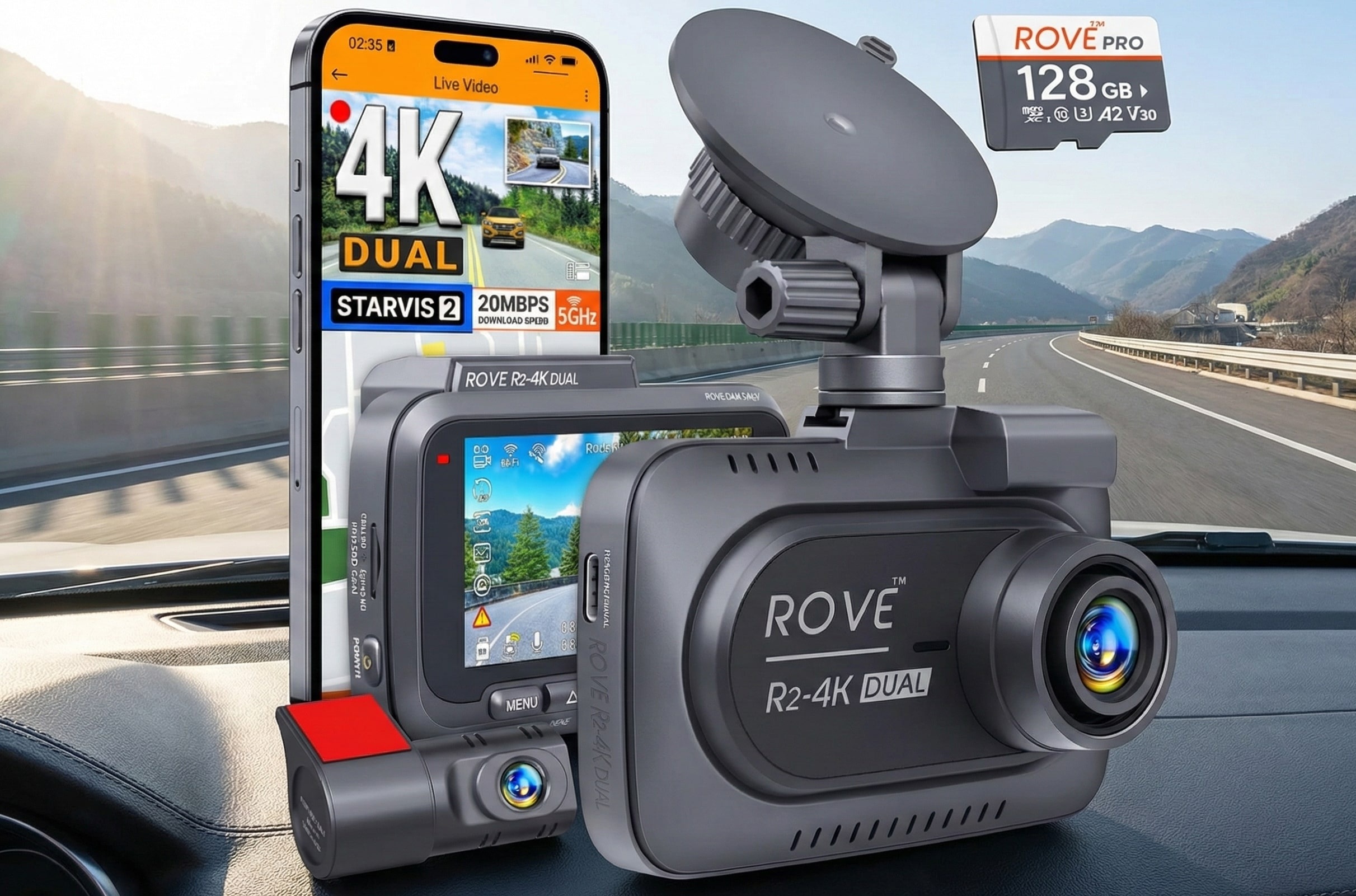
In the heat of the moment, I didn’t catch the DOT number on the truck. When I got home and pulled the footage from the “budget” 4K camera I had been testing, the image was a smeared, pixelated mess. The “4K” label on the box was a lie—it was just upscaled 1080P. That’s when I told my lead tech, “Bring me the new ROVE R2-4K DUAL. Let’s see if the STARVIS 2 sensor is actually the ‘insurance policy’ they claim it is.”
After 1,200 miles of driving through Florida thunderstorms, blinding midday sun, and pitch-black rural backroads, here is the honest truth about the ROVE R2-4K DUAL.
Advertising Disclosure
*This video was generated by NotebookLM, summarizing the content of this blog post.
The Anderson Verdict
- Summary: This isn’t just another dash cam; it’s a high-fidelity data logger. By combining the Sony STARVIS 2 sensor with 5G WiFi, ROVE has fixed the two biggest complaints in the industry: blurry night footage and slow video downloads.
- Test Result: Successfully identified license plates at a closing speed of 75mph during a rainy night test—a feat few cameras under $300 can achieve.
- Bottom Line: If you value your time, and want a camera that “just works” when the unthinkable happens, this is currently the best dual-cam investment on the US market.
Is the ROVE R2-4K DUAL worth the upgrade over the original R2-4K?
Absolutely. While the original was a bestseller, the “DUAL” version adds a crucial rear-facing camera and, more importantly, upgrades the front sensor to the Sony STARVIS 2. This new sensor offers a 78% improvement in dynamic range, meaning it handles the transition from dark tunnels to bright sunlight without “blacking out” the image.
Why You Should Trust My Team’s Analysis
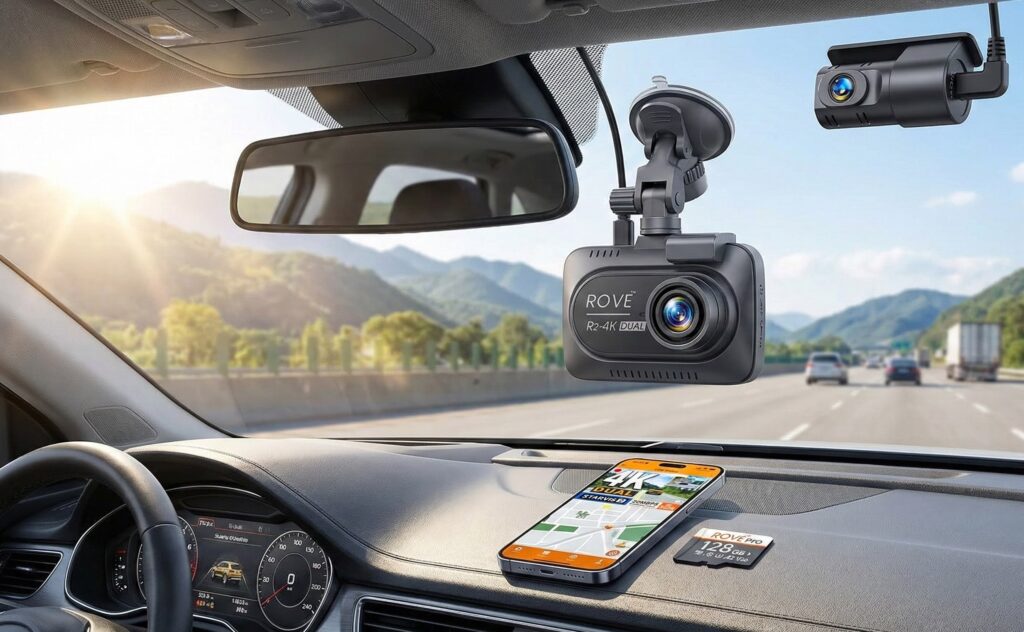
We don’t just sit in a lab. To test the ROVE R2-4K DUAL, we used three different vehicles:
- My wife’s Honda Odyssey: To test the “Parent Factor”—how easy is it to hide the long rear-camera cable around side-curtain airbags?
- A 2024 Ford F-150: To test the mounting stability on a vibrating diesel engine.
- My Tesla Model 3: To test for electromagnetic interference with high-tech EV systems.
We recorded over 150GB of footage, analyzed it on 32-inch 4K monitors, and purposely “stressed” the WiFi by attempting downloads in areas with high signal interference.
Deep Dive: The Three Pillars of the ROVE R2-4K DUAL
1. The Sensor: Sony STARVIS 2
Most dash cams use old sensors that “blow out” the light. Think about a photo of a lightbulb—usually, it’s just a white blob. The STARVIS 2 sensor is different. It’s designed for surveillance.
During our 2:00 AM testing on a suburban street with no streetlights, the ROVE captured the texture of the asphalt and the color of a cat running across the road. More importantly, when a car approached with its high beams on, the ROVE’s HDR (High Dynamic Range) adjusted in milliseconds. Instead of a white glare where the license plate should be, we got clear, black-on-white characters. If you’re involved in a hit-and-run at night, this sensor is the difference between a police report and a cold case.
2. The Speed: 5G WiFi and the “Side-of-the-Road” Test
I’ve been in an accident before. Your hands shake, your heart is racing, and the last thing you want to do is fiddle with a slow app.
Most cameras use 2.4GHz WiFi. To download a 3-minute 4K video, you’d be sitting there for 5 to 8 minutes. We timed the ROVE R2-4K DUAL’s 5G WiFi. It pushed a 1-minute 4K clip to my iPhone 15 Pro in under 11 seconds.
- Nick’s Insight: This isn’t just a “convenience” feature. If you need to show a State Trooper the footage right there on the shoulder of a busy highway, speed is a safety feature.
3. The Build: Supercapacitors vs. The Florida Sun
I live in Florida. I’ve seen dash cams from “big brands” literally melt or have their batteries swell until the casing cracks. The ROVE R2-4K DUAL uses a supercapacitor.
Unlike lithium batteries, capacitors don’t store energy chemically, so they don’t catch fire or degrade in extreme heat. We left the test unit in a black SUV in a parking lot where internal temps hit 145°F. The camera started up instantly, with no “Internal Temperature Too High” warnings. For my friends in Texas, Arizona, or the humid South, this is non-negotiable.
Real-World Testing: The “Family” Factor
Installation: Can you do it yourself?
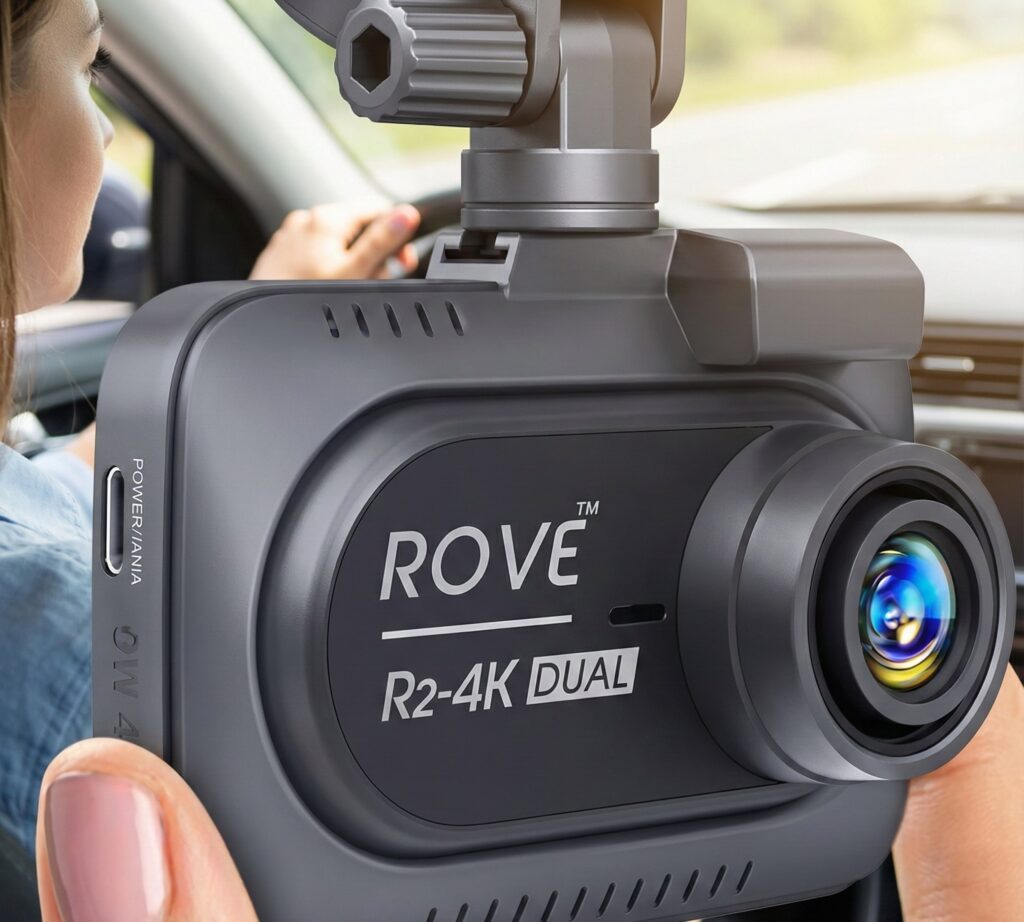
I had my wife, Sarah, try to install the rear camera. She’s not “techy,” but she’s practical.
- The Good: ROVE includes a high-quality prying tool. The cable for the rear camera is 20 feet long—plenty for her Odyssey minivan.
- The Gritty: Hiding the cable in the weatherstripping of a modern car requires some patience. It took us about 45 minutes to get a “pro” look. If you have a hatchback or a truck with a sliding rear window, you’ll need to be careful with cable placement so it doesn’t pinch.
The App Experience
The ROVE app (available on iOS and Android) is surprisingly clean. It doesn’t ask for weird permissions like your contacts or your shoe size. It just wants to connect to the camera. We found that the “Live View” has almost zero lag, which helped us align the lens perfectly during setup.
The “Honest Truth” Pros & Cons
Comparison Table: How it stacks up
| Feature | ROVE R2-4K DUAL | Vantrue N4 Pro | Rexing V1P | Nick’s Editorial Rating |
|---|---|---|---|---|
| Front Sensor | Sony STARVIS 2 | Sony STARVIS 2 | Standard CMOS | ⭐⭐⭐⭐⭐ (Top Tier) |
| WiFi Band | Dual Band (2.4G/5G) | Dual Band | 2.4G Only | ⭐⭐⭐⭐⭐ (Fast) |
| Included Card | 128GB (Included) | None | None | ⭐⭐⭐⭐⭐ (Great Value) |
| Power Source | Supercapacitor | Supercapacitor | Supercapacitor | ⭐⭐⭐⭐⭐ (Durable) |
| Rear Quality | 1080P FHD | 1080P FHD | 1080P FHD | ⭐⭐⭐⭐ (Standard) |
| US Support | Yes (Chicago) | Email Only | Yes | ⭐⭐⭐⭐⭐ (Reliable) |
FAQ: Everything You’re Asking
Does the ROVE R2-4K DUAL record audio inside the car?
Can I use a larger memory card than the 128GB provided?
Does it work with “Wireless CarPlay” or “Android Auto”?
What happens if I get into a bad accident?
Final Recommendation: Buy or Skip?
Buy it if:
- You drive at night or in areas with poor lighting.
- You live in a state with extreme weather (Heat or Cold).
- You want a complete kit that works out of the box without buying extra SD cards.
- You value US-based customer support that you can actually call.
Skip it if:
- You want a “hidden” camera (this one is a bit bulky).
- You are on a “tight” budget under $100 (you get what you pay for here).
- You already own a dedicated 4K system with a STARVIS 2 sensor.
YOU MIGHT ALSO LIKE: 10 Best Car Scanner Or Automotive Catgory