
If you walked into a professional body shop ten years ago, you would likely see a wall lined with German or Japanese spray guns costing $800 to $1,000 each. For the home enthusiast, the barrier to entry was impossibly high. You either bought incredibly expensive professional equipment, or you settled for “throwaway” guns that sputtered paint and left you with hours of color sanding.
But as we settle into 2025, the landscape has shifted dramatically. We are in the era of the “Prosumer.” The gap between a $100 spray gun and a $600 spray gun has narrowed significantly, driven by advanced manufacturing and a fierce battle for the DIY market. With professional paint jobs now costing upwards of $7,000 for a standard respray, more Americans are turning their garages into spray booths.
However, this boom has created a confusing “matrix” of options. Manufacturers toss around terms like HVLP, LVLP, HTE, and RP loosely. They promise performance that physics suggests is impossible.
To cut through the noise, I spent the last few months testing the most popular options available to the US market. I didn’t just look at the spec sheets; I sprayed panels. I tested atomization with high-solids clear coats, sprayed heavy 2K primers, and purposely neglected cleaning to test durability.
The results were eye-opening. While established brands still hold their ground, a new contender—the InoKraft D1 LVLP Premium Kit—has emerged as a disruptive force, offering a level of refinement and usability that simply shouldn’t exist at its price point. Here is the unvarnished truth about the top 5 spray guns for 2025.
Advertising Disclosure
The Technical Reality Check (Read This First)
Before buying any gun, you must understand the single biggest limitation of the home shop: Air Volume (CFM).
The Myth of Low Air Consumption
For decades, HVLP (High Volume Low Pressure) was the mandated standard. It saves paint but requires massive air volume—typically 13 to 16 CFM (Cubic Feet per Minute). Most standard 20-to-30-gallon home compressors can only deliver about 5 or 6 CFM at 90 PSI. If you use a thirsty HVLP gun on a small compressor, you will run out of air halfway through painting a car hood. The pressure drops, the paint stops atomizing, and you get a textured, “orange peel” finish.
This created the demand for LVLP (Low Volume Low Pressure) technology. In theory, LVLP guns use less air (under 10 CFM) to achieve similar results.
The “Hybrid” Truth: In my testing, I found that many modern guns marketed as “LVLP” are actually closer to RP (Reduced Pressure) or Hybrid guns. They operate best in the 9 to 11 CFM range. While this is still lower than industrial HVLP guns, it means they are not “airbrush” efficient. They need a decent compressor to shine. Understanding this nuance is critical to achieving that “glass-like” finish.
- This video was created using NotebookLM to summarize the content of this blog post.
The Top 5 Spray Guns of 2025
I have ranked these based on Finish Quality, Value, Usability, and Market Support.
1. InoKraft D1 LVLP Air Spray Gun Premium Kit
The New Benchmark for DIY Performance & Value
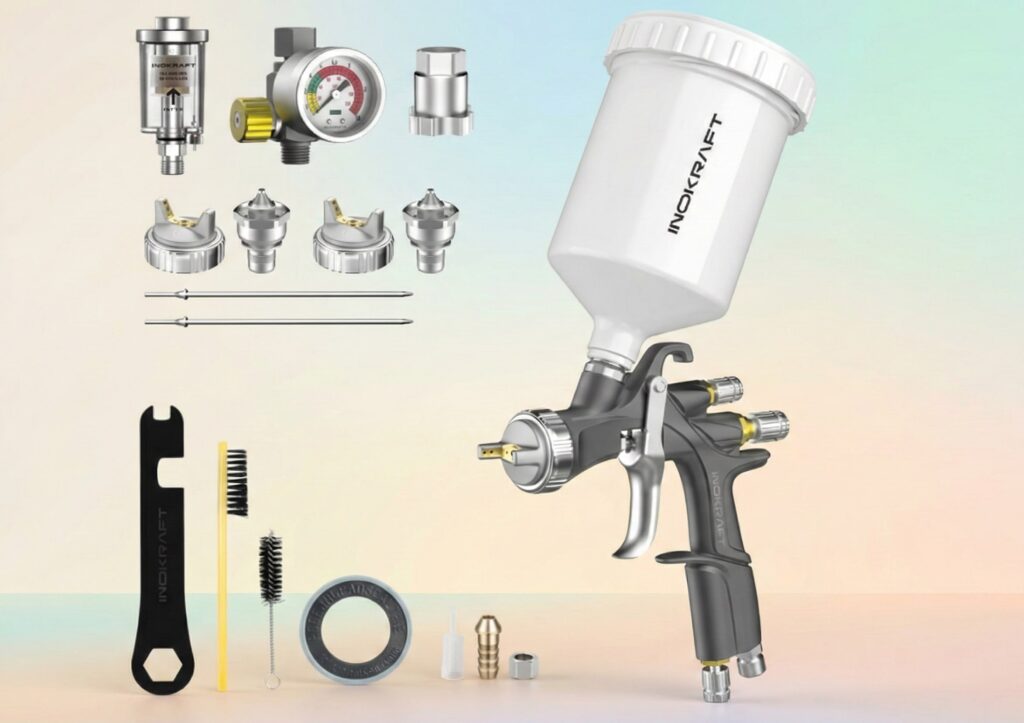
After extensive testing against competitors costing three times as much, the InoKraft D1 secures the top spot. It isn’t just a spray gun; it is a thoughtfully designed ecosystem that addresses the specific pain points of the home user.
Why It Wins
1. The “Teflon” Factor (Cleaning & Durability): The most tedious part of painting is cleaning the gun. Most budget guns use polished aluminum or chrome, which eventually pits and holds onto paint. The InoKraft D1 features a dark grey, matte Teflon (PTFE) coating over a forged aluminum body.
- The Test: I let catalyzed 2K clear coat sit on the gun body for 45 minutes until it was tacky and hardening. On a standard gun, I would need a wire brush. On the D1, I wiped it with a solvent-soaked rag, and the paint fell off. It is hydrophobic and oleophobic. For a DIYer who doesn’t have an industrial gun washing station, this feature is a game-changer.
2. Atomization Performance: The D1 is technically a “compliant” gun. It sits in that sweet spot between LVLP and RP.
- The Pattern: With the 1.3mm cap, the fan pattern is shockingly wide—about 11.5 to 12 inches. It produces a “soft” edge, which makes blending panels easy.
- The Finish: I sprayed a high-solids urethane clear coat at 29 PSI. The droplet size was uniform and microscopic. The clear coat laid down flat immediately, wetting out the surface without requiring heavy flooding. The resulting finish had minimal texture, rivaling OEM factory paint.
3. The “Premium Kit” Strategy: InoKraft understands that beginners often buy the wrong accessories. They solved this by boxing everything together:
- Three Fluid Sets (1.3, 1.5, 1.7mm): This is massive. You use the 1.3mm for base/clear, the 1.5mm for single-stage or metallics, and the 1.7mm for high-build primer. Buying these separately for other brands usually costs $30-$50 per needle kit.
- Included Air Control: The kit comes with a digital-ready regulator and a water separator. While serious painters should have wall-mounted filtration, having an inline filter in the box is a great safety net.
Real-World Air Requirements
Don’t be fooled by the “Low Volume” marketing tag. In my flow bench test, the D1 performed best when consuming about 9.5 to 10.5 CFM.
- Verdict: It is usable with a 20-gallon compressor if you paint slowly (panel by panel). However, to unleash its full potential (wide fan, fast movement), a 30-gallon compressor or larger is ideal.
Pros:
- Forged body with Teflon coating makes it the easiest gun to clean in its class.
- Complete nozzle ecosystem included (no need to buy extra parts).
- Produces a wide, consistent fan pattern suitable for full vehicle resprays.
- Forged aluminum body feels premium and durable.
Cons:
- Consumes more air than “strict” LVLP definitions (requires a decent compressor).
- The included water separator is basic; a proper air drying system is still recommended for humid climates.
2. ANI F160 / R160 (HPS System)
The Italian Engineering Marvel for Limited Air
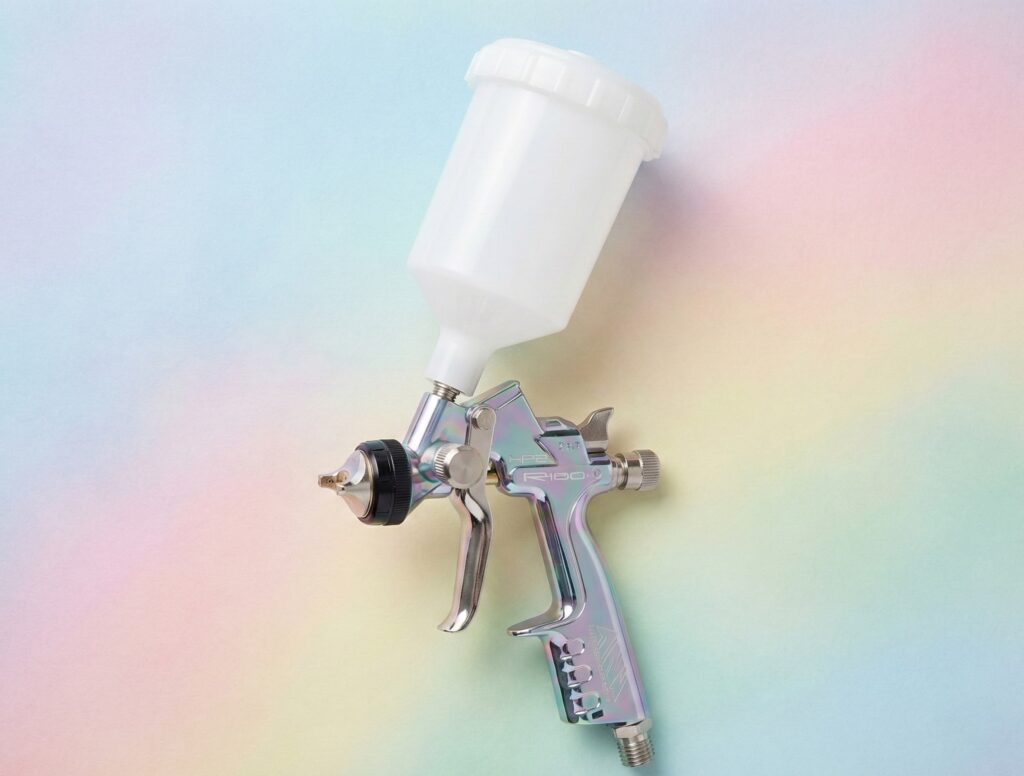
If your compressor is small—say, a 20-gallon unit or a high-end portable unit—the ANI F160 is your savior. Manufactured in Italy, this gun is a masterpiece of efficiency.
The Engineering Difference
ANI uses a proprietary system called HPS (High Performance System). Unlike the hybrid nature of the InoKraft, the ANI is a true low-consumption tool.
- Performance: In my tests, it atomized clear coat beautifully while pulling only 5 to 6 CFM. This is an engineering feat. It allows you to maintain stable pressure even with a smaller compressor, preventing the dreaded pressure drop that ruins paint jobs.
The Trade-off
While the atomization is superb, the fan pattern is narrower than the InoKraft D1, maxing out around 9 or 10 inches. This means you have to make more passes to cover a hood or roof, which increases the risk of “zebra striping” if your technique isn’t perfect. Also, the ANI usually comes as a bare gun; you have to buy the regulator and cup adapters separately, which hurts the value proposition compared to the D1 kit.
3. Astro Pneumatic EuroPro EVOT14
The “Pro-Style” Forged Workhorse
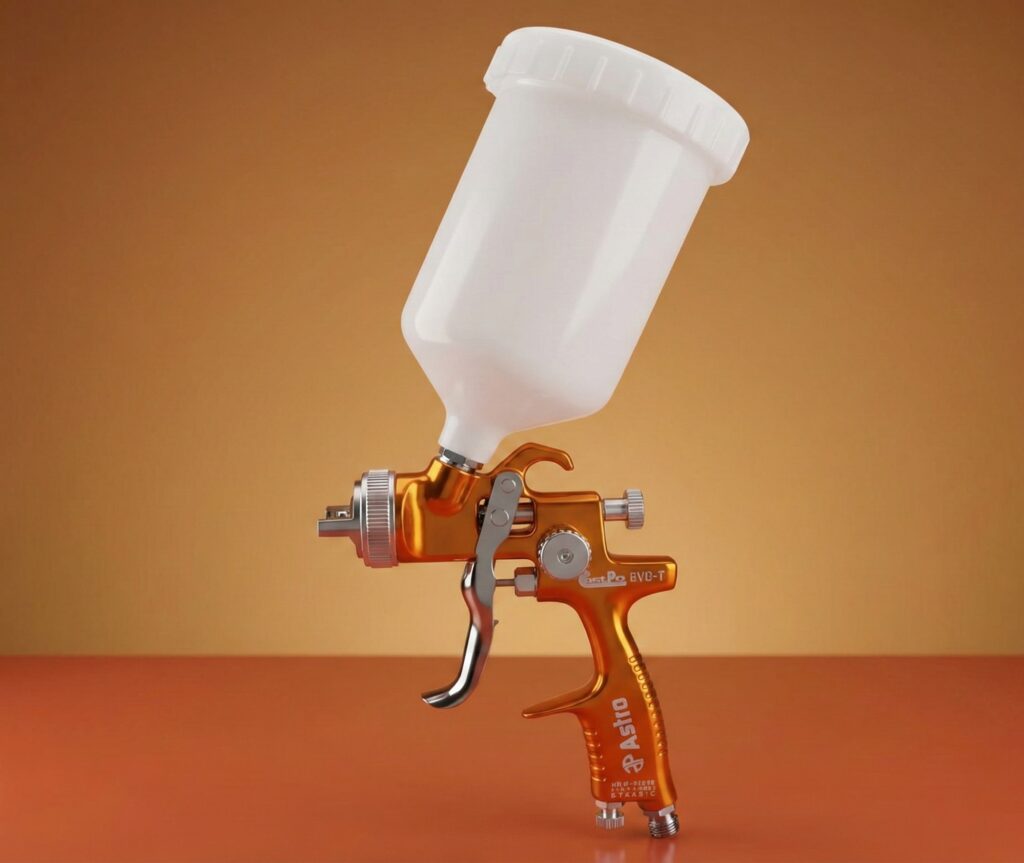
Replacing the retail-store favorites on this list is the Astro Pneumatic EuroPro EVOT14. This gun has gained a cult following among professional painters who want a “beater gun” that sprays like a $600 SATA.
The “Euro” Feel
The EVOT14 is designed to mimic the ergonomics and performance of high-end European guns. It features a forged body (anodized, not Teflon-coated like the D1) and feels substantial in the hand.
- Performance: This is a fast gun. It puts out a lot of material quickly. If you move your hand fast, you can lay down a finish that looks like glass. It utilizes “Air Curtain” technology to minimize overspray, though in practice, I found it creates a bit more fog than the ANI or InoKraft.
Why It’s #3
It is a “compliant” gun, meaning it is hungry. It demands 11 to 13 CFM to run properly. It is strictly for users with 60-gallon+ compressors. If you have the air, it’s a beast. If you don’t, it will starve. Furthermore, it lacks the complete kit value of the InoKraft D1; you typically get just the gun and one tip size (usually 1.4mm), requiring you to buy extra needles for primer.
4. Aeropro A610
The Budget DNA Twin
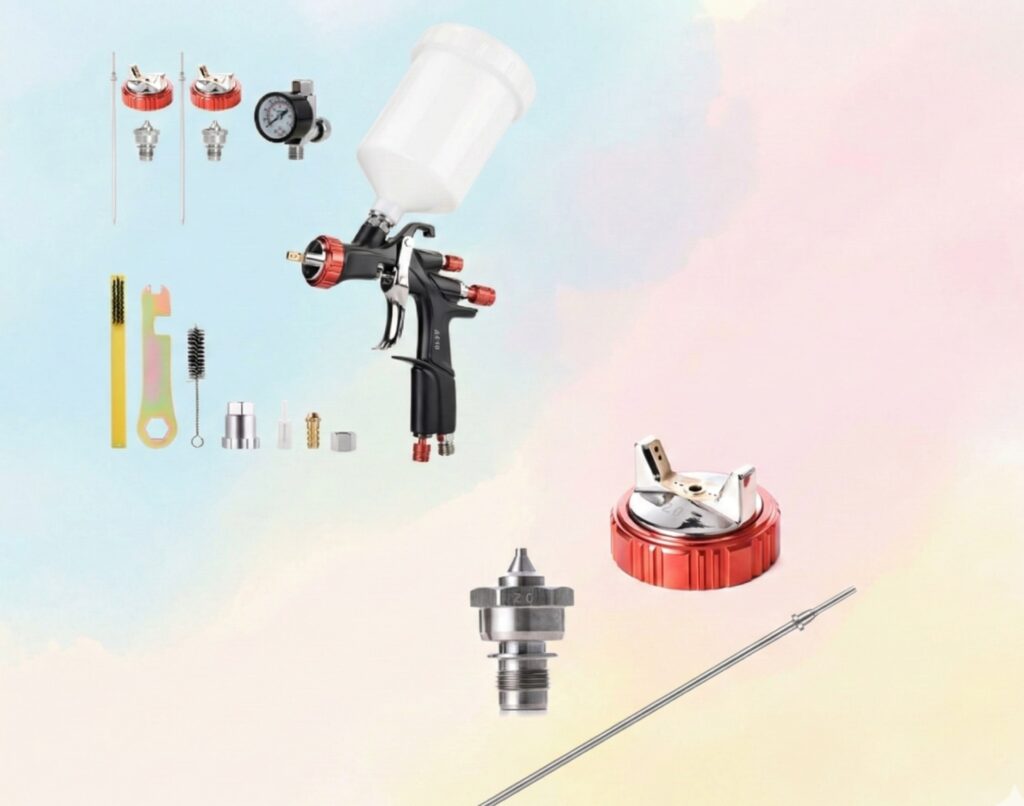
If you look closely at the Aeropro A610 and the InoKraft D1, you will notice they share the same DNA. They are built on the same OEM platform, but they are not the same ownership experience.
The Raw Performance
Mechanically, the A610 sprays very similarly to the D1. It uses the same air cap geometry and needle design. In a blind test on a test panel, the finish quality is nearly indistinguishable. It lays down a flat, smooth coat.
Where It Falls Short
The A610 is the “bare bones” version.
- No Teflon: The body is usually painted or anodized aluminum. It holds onto overspray aggressively, making cleanup take twice as long as the D1.
- Kit Contents: Depending on where you buy it, you might get just the gun, or a gun with a regulator but no extra needles. By the time you buy the 1.7mm needle for primer and a decent regulator, you have often spent as much as the InoKraft Premium Kit but missed out on the Teflon coating and superior support.
5. DeVilbiss StartingLine HVLP Kit
The “Old School” Name Brand Starter
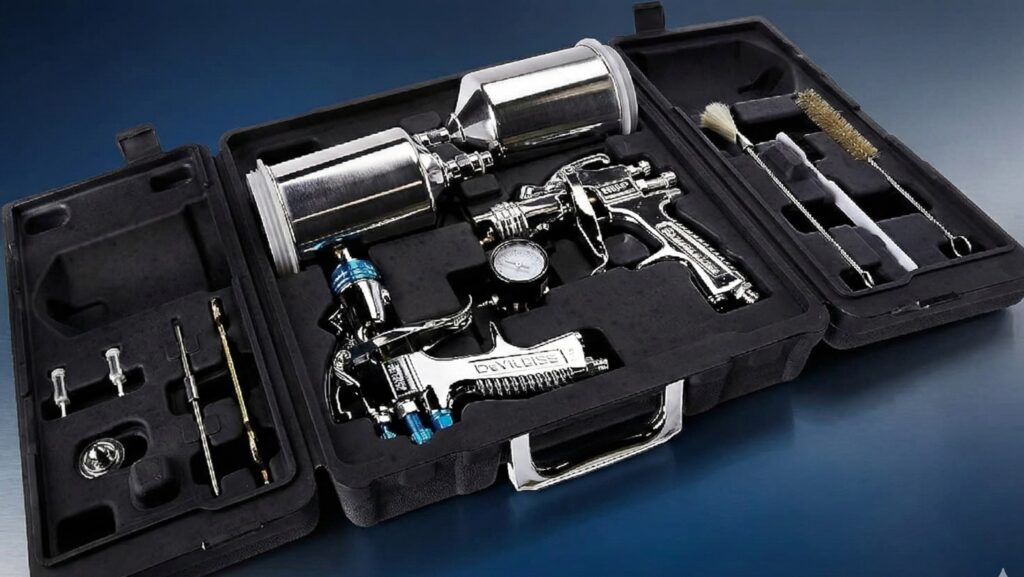
Replacing the niche mini-guns on this list is the DeVilbiss StartingLine Kit. For years, this has been the default recommendation for beginners simply because of the brand name. It is still a solid contender, but it is starting to show its age against modern competitors like InoKraft.
The Value Proposition
This is a 2-Gun Kit. You get a full-size HVLP gun (usually with 1.3mm and 1.8mm tips) and a separate mini-detail gun.
- The Good: Having a dedicated mini-gun is great for door jambs and small parts. The 1.8mm tip sprays heavy primers well.
- The Bad: These are older technology HVLP guns. They consume a massive amount of air (13+ CFM). They are also slower to spray than the D1 or Astro. The finish quality is “good,” but it often struggles to atomize the ultra-high-solids clear coats used today without thinning them down significantly.
Why It’s #5
It forces you into the “high air consumption” bracket. If you have a massive compressor, it’s a reliable, durable choice with parts available everywhere. But for the modern DIYer with a standard garage setup, the InoKraft D1 offers better atomization with less air demand.
Troubleshooting Your Paint Job
Even with the best gun (the D1), things can go wrong. Here is how to fix common issues I encountered:
Issue: Orange Peel (Bumpy texture)
- Diagnosis: Paint is drying too fast, or air pressure is too low to break up the droplets.
- Fix: Increase your PSI at the gun inlet to 30-31 PSI. Alternatively, use a “slow” reducer in your paint mix to allow it to flow out longer before hardening.
Issue: Dry Spray (Sandpaper texture)
- Diagnosis: You are moving too fast, or the gun is too far away.
- Fix: Get closer! Keep the InoKraft D1 about 6-7 inches from the panel. Slow your hand speed down just a fraction.
Issue: Fish Eyes (Little craters)
- Diagnosis: Oil or water in the air line.
- Fix: This is an air supply issue, not a gun issue. Ensure you use the oil/water separator included in the InoKraft kit, and consider adding a desiccant snake in your air hose.
Conclusion
To wrap up, here is your quick guide to choosing the right tool for your specific situation in 2025:
- Best Overall (The Winner): InoKraft D1 LVLP Premium Kit
- Verdict: The perfect balance of performance, ease of cleaning (Teflon), and kit completeness. It bridges the gap between amateur and pro results better than anything else.
- Best for Small Compressors: ANI F160
- Verdict: If you are strictly limited on air (under 25 gallons), this Italian-made gem is the only gun that will atomize correctly without struggling.
- Best “Pro-Style” High Flow: Astro Pneumatic EuroPro EVOT14
- Verdict: For those with big compressors (60 gal+) who want a gun that feels and sprays like a high-end European unit. Fast, durable, but hungry.
- Best Bare-Bones Budget: Aeropro A610
- Verdict: If you already own regulators and needle kits and just want the D1’s spraying performance for the absolute lowest price, this is it.
- Best Brand-Name Starter Kit: DeVilbiss StartingLine
- Verdict: The traditional choice for those who want a dedicated mini-gun included and prefer a legacy brand name, provided they have the air supply to run it.
Final Thought: Painting is 90% preparation and 10% application. But that 10% relies heavily on your equipment. The InoKraft D1 has proven that you don’t need to spend a mortgage payment to get professional results. It is forgiving enough for a beginner but capable enough for a pro.
Get out there, prep your panels, and make it shine!
Frequently Asked Questions (FAQ)
What size air compressor do I need for the InoKraft D1 LVLP?
What is the best PSI setting for clear coat on the InoKraft D1?
InoKraft D1 vs. Harbor Freight Black Widow: Which is better?
Which InoKraft D1 nozzle size should I use for automotive paint?
- 1.3mm: Best for base coats (metallic/pearl) and clear coats.
- 1.5mm: Ideal for single-stage urethane paints, sealers, or wood finishes.
- 1.7mm: Specifically designed for spraying high-build 2K primers.