
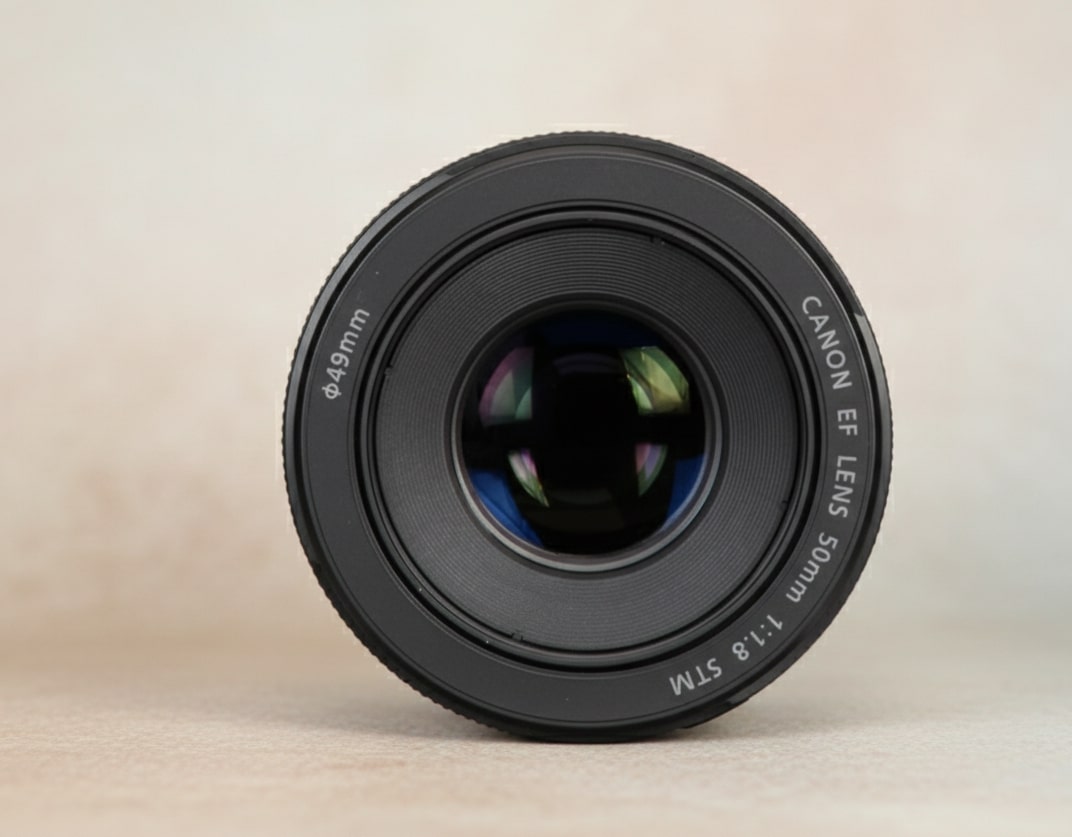
If you shoot Canon, you know the name: the “Nifty Fifty.” It’s the lens that, for generations of photographers, has served as the ultimate gateway to beautiful, professional-looking images. We put the current generation—the Canon EF 50mm f/1.8 STM—to the test to see if this lens still delivers the exceptional value and optical quality that made it a legend.
Here is our honest, detailed review of this compact prime lens for the American photography community.
Advertising Disclosure
1. Ergonomics and Build Quality: The Metal Mount Upgrade
The most significant physical improvement Canon made to this lens was addressing the main complaint of its predecessor: the build quality.
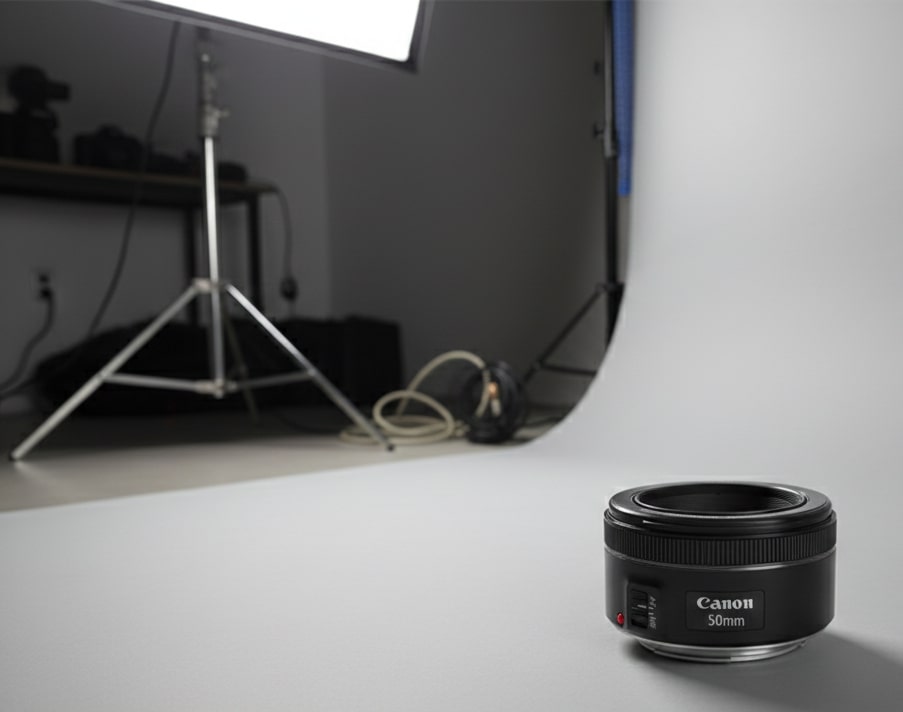
We found that the EF 50mm f/1.8 STM now feels significantly more robust. The exterior casing is made of a matte black polycarbonate that provides a solid, non-slip grip. Crucially, Canon upgraded the connection point to a metal lens mount. This change vastly improves long-term durability and stability, giving us confidence that the lens connection won’t wear down after years of frequent attachment and removal.
Its size is barely larger than a body cap, weighing just 5.7 oz (160g). This makes it an ideal walk-around lens for daily shooting or travel, especially when paired with a compact DSLR like a Rebel or adapted to a mirrorless EOS R body.
2. Optical Performance: Sharpness and Bokeh
This is why you buy the lens: the image quality far exceeds what its size suggests.
Sharpness Breakdown
The EF 50mm f/1.8 STM uses a classic optical formula, and our tests show strong performance, especially when stopped down slightly:
- At f/1.8 (Wide Open): The center of the image is tack sharp. Like many large-aperture lenses, the extreme edges and corners show some softness and vignetting (darkening), but this is rarely an issue for portraiture, where the subject is central and the background is deliberately blurred.
- At f/2.8 to f/4: This is the sweet spot. When stopped down just one or two stops, the lens achieves exceptional sharpness across the frame, rivaling far more expensive glass. We recommend shooting portraits at f/2.2–f/2.8 for the best balance of background blur and critical sharpness on your subject.
Bokeh Quality (Background Blur)
A major design change that benefits the image quality is the switch from five straight aperture blades to seven rounded aperture blades. This is critical for achieving professional-looking bokeh. The result is smoother, more circular highlights in the out-of-focus areas, creating a creamier, more pleasing background blur compared to the harsher pentagons produced by the older version.
3. Autofocus and Video Performance (The STM Difference)
The “STM” (Stepping Motor) designation is Canon’s technology for smoother, quieter autofocus, primarily geared toward video.
- Still Photography: The AF speed is quick and accurate enough for general use, street photography, and most portrait sessions. It provides reliable focus lock, especially at f/1.8, which is crucial when dealing with an extremely shallow depth of field.
- Video Recording: The STM motor excels at delivering smooth focus transitions during video, minimizing the jarring effect of older, jumpy AF motors. However, it is important to note that the STM motor is not completely silent. In quiet indoor environments, the camera’s internal microphone may pick up a faint electrical buzzing or clicking noise as the lens adjusts focus. We advise using an external microphone for professional video work.
Critical User Note: Focus-by-Wire
A frequent source of user confusion, especially in social forums, is the manual focus ring. This lens uses an electronic Focus-by-Wire system.
Important: The manual focus ring will not work if the camera is off or in sleep mode. You must half-press the shutter button or activate the camera’s metering system to power the motor, allowing the manual focus ring to move the glass elements. If you try turning the ring while the camera is off and nothing happens, the lens is not broken—it’s operating normally.

4. Competitive Analysis: Value vs. Risk
For photographers in the US, the main choices typically fall between this Canon lens and cheaper third-party alternatives.
When evaluating third-party options, while they may offer comparable central sharpness, they often fall short in overall user experience and long-term reliability. The Canon STM consistently delivers superior AF consistency and build quality. For a lens that serves as a core tool in your kit, the reliability of the Canon EF 50mm f/1.8 STM is an investment worth making over the risk of potential focus issues or poor longevity with a less-established brand.
Our Verdict: A Timeless Staple
The Canon EF 50mm f/1.8 STM remains one of the smartest purchases a Canon photographer can make. It is a lens that forces creative movement and teaches you the fundamentals of depth of field, acting as an essential tool to elevate your image quality far beyond what a standard kit lens can achieve. Whether you are shooting flattering portraits (at the 80mm equivalent on an APS-C camera) or capturing low-light scenes, this lens is an indispensable addition to your gear bag.
YOU MIGHT ALSO LIKE: Apple AirTag Review [2025], The 6 Best Wireless CarPlay Adapters of 2025