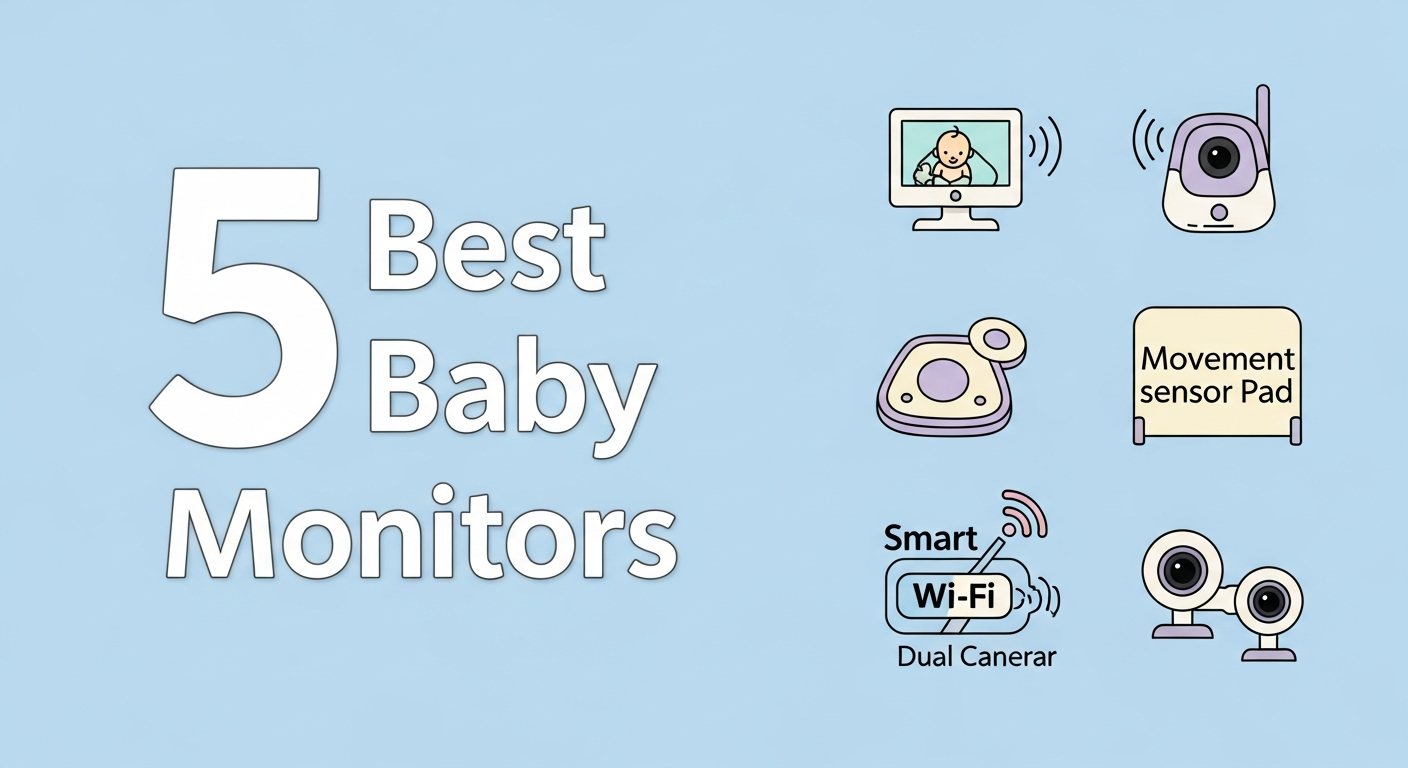
Let’s get right to it. The best baby monitors for most parents are the Infant Optics DXR-8 Pro (for best-in-class non-Wi-Fi security) and the Nanit Pro (for the best Wi-Fi and sleep-tracking smart features). However, the “best” monitor is a deeply personal choice that depends entirely on your family’s needs, your home’s layout, and your own anxiety levels. This review is essential reading because choosing the wrong type of monitor—like a Wi-Fi model when you secretly fear hackers, or a non-Wi-Fi model when you need to check in from work—can end up causing more stress, not less.
Read on to discover which category of monitor will actually let you close your eyes and sleep.
The Silence of the Nursery
Let’s be honest. That first night home from the hospital… did you sleep?
Or did you, like most of us, spend the entire night just… staring? Staring at the rise and fall of that tiny chest in the bassinet, your heart leaping into your throat at every sigh, grunt, or—worst of all—every long, terrifying pause.
The silence of a nursery is a strange, heavy thing. It’s the new-parent paradox: you are utterly exhausted, but you are too terrified to sleep.
Your brain is hijacked by a single, looping track of “What ifs.” “Are they okay?” “Are they breathing?” “Was that a cry, or the house settling?” “Should I go check? Just one more time?”
This is the exact moment we realize we need a “helper.” A set of trusted eyes and ears that can stand guard when we can’t. We need a baby monitor.
But as a shopping expert who has analyzed thousands of reviews and the raw, sleep-deprived psychology of new parents, I can tell you this: we aren’t just buying a piece of technology. We are buying Peace of Mind.
And in the U.S. market, that purchase comes down to one fundamental, non-negotiable choice.
Advertising Disclosure
The Great Debate: “Team Security” vs. “Team Connection”
Before you look at a single brand, you must answer this: Are you more afraid of a hacker or of not knowing?
Your answer splits the entire market in two.
1. Team Non-Wi-Fi (a.k.a. “Team Security”)
These are closed-loop, or FHSS, monitors. The camera communicates only with the dedicated handheld video screen (the “parent unit”) it came with. It does not, and cannot, connect to your home’s internet.
- Who is this for? The parent who has read the horror stories. The parent who values 100% privacy. The parent who believes simplicity equals reliability.
- The Emotional Pull: It is impossible to hack. It is a secure, air-gapped, private line between you and your baby. It has zero lag, so when you hear a cry on the monitor, you’re hearing it now, not 4 seconds later after it’s been to a server and back.
- The Downside: You are tethered to that parent unit. The range is limited to your house (and maybe the front porch). You cannot check in from the office. You cannot check in from your date night.
2. Team Wi-Fi (a.k.a. “Team Connection”)
These are “smart” monitors. The camera connects to your home’s Wi-Fi, sending the video feed to an app on your smartphone and (often) to the cloud.
- Who is this for? The working parent. The data-driven parent. The parent who needs the flexibility to check in from anywhere, anytime.
- The Emotional Pull: The freedom. You can be at your desk at work, open an app, and see your baby sleeping peacefully. You get high-definition 1080p video. You get “smart” features: sleep tracking, breathing monitoring, and AI-powered alerts.
- The Downside: It is only as reliable as your Wi-Fi. If your internet goes down at 3 AM, your monitor is a useless, expensive piece of plastic. And, you are placing your trust in a company’s security servers.
Now that you know which “Team” you’re on, let’s look at the champions for each. Here are the heroes that have earned the trust of millions of American parents.
The Best Baby Monitors That Actually Let Parents Sleep
1. Infant Optics DXR-8 Pro: The Fort Knox of Baby Monitors
Category: Non-Wi-Fi (Best for Security & Reliability)
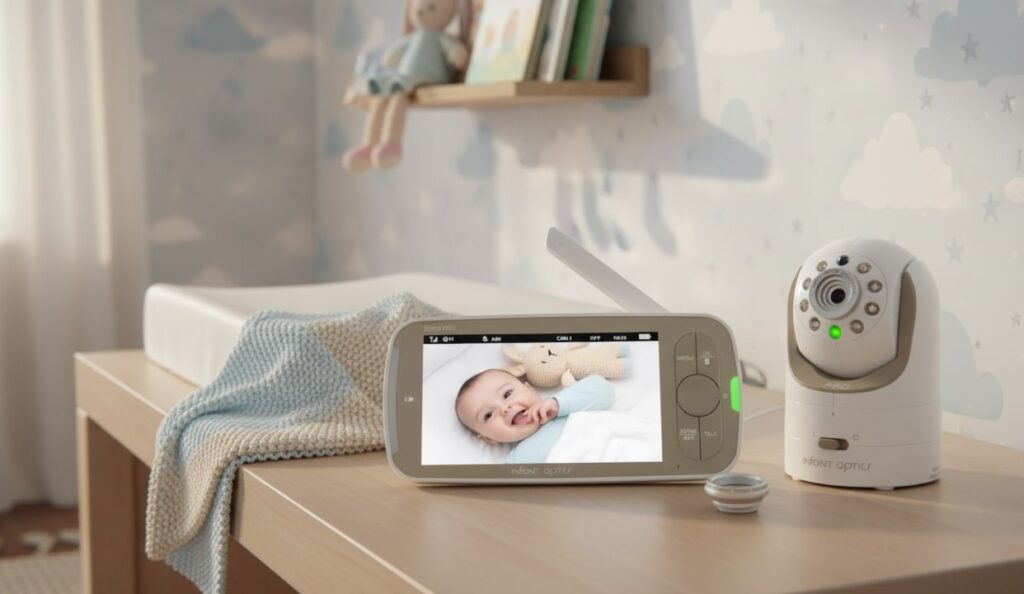
If you ask ten U.S. parents for a monitor recommendation, five of them will say “Infant Optics.” This isn’t just a monitor; it’s an institution. It is the gold standard for parents who put security and reliability above all else.
- Detailed Pros (Where the Peace of Mind Comes From):
- 100% Hacker-Proof Security: This is its crown jewel. The signal is “closed-loop.” It never touches your Wi-Fi. It never goes online. There is no app. There is no password for a hacker to steal. It is, quite simply, the most private and secure video connection you can get.
- Zero Lag, Instant Feedback: Because the signal travels directly from the camera to the parent unit, it’s instantaneous. When your baby coughs, you see and hear it at that exact moment. This immediate connection is incredibly reassuring.
- Active Noise Reduction (ANC): This is a marriage-saving feature. With the press of a button, it filters out all background “hiss” — the fan, the air conditioner, the white noise machine. The monitor becomes dead silent… until the baby makes a sound. You can finally sleep without the constant static, trusting that it will wake you only when you’re needed.
- Interchangeable Lenses: This is a pro feature. It comes with a standard lens, but you can swap on a true optical zoom lens (sold separately or bundled) to get a close-up without losing digital quality, or a wide-angle lens for when they’re older.
- The Realistic Cons
- The 720p screen is “functional,” not “beautiful.” It’s not your iPhone 15.
- You are on a “leash.” The parent unit is your only window. You can’t run to the mailbox or take the trash out without losing signal.
- The battery life on the parent unit is decent, but not eternal. You’ll likely be charging it every night.
2. Nanit Pro: The PhD in “Baby-ology”
Category: Wi-Fi (Best for Data & Working Parents)
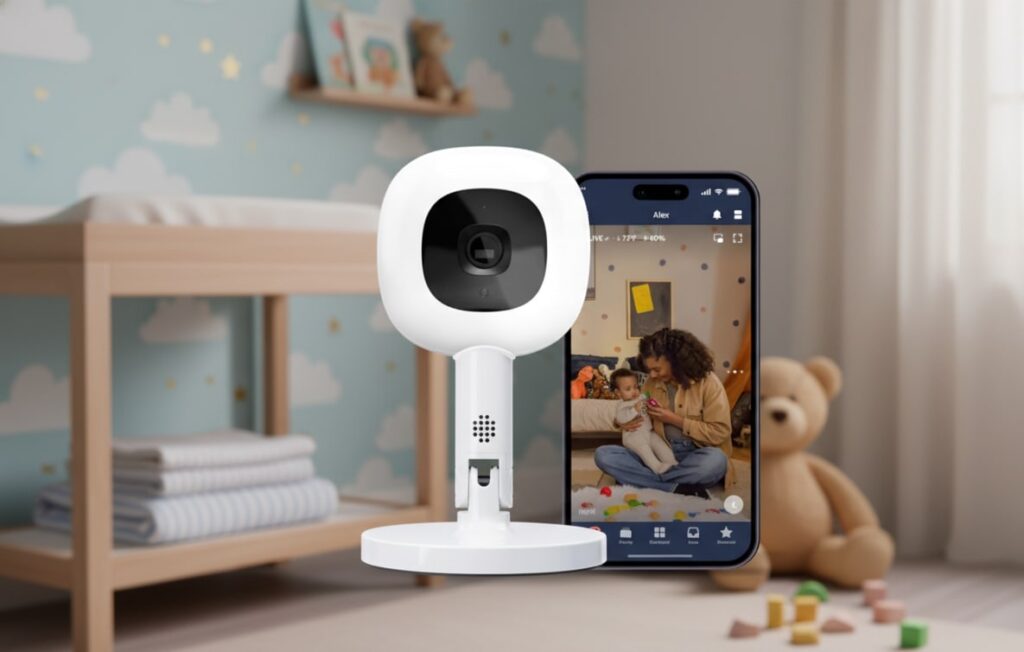
The Nanit isn’t just a camera; it’s an intelligence-gathering system. This is for the parent who wants to understand their baby’s sleep, not just watch it.
- Detailed Pros (Where the Peace of Mind Comes From):
- Unmatched Image Quality: The 1080p overhead “bird’s-eye view” is spectacular. It’s crystal clear, even in pitch-black darkness. You can zoom in on your phone and literally see the gentle rise and fall of your baby’s chest, which is profoundly calming.
- Sleep Analytics (The “Insights”): This is the magic. Every morning, Nanit sends you a report and a video highlight reel. It tells you exactly:
- When your baby fell asleep.
- How long it took them to fall asleep.
- How many times they woke up.
- How long you took to go in and check on them. It gamifies sleep training and gives data-driven parents the information they crave.
- Breathing Wear Monitoring: Nanit uses a special swaddle or band with a printed pattern. The camera tracks this pattern to monitor breathing motion. There are no electronics on your baby. For many parents, this is a massive win, providing breathing alerts without the anxiety of a wearable device.
- The App & Background Audio: The app is stable and polished. The “background audio” feature is brilliant: you can turn your phone screen off and browse other apps, but you’ll still hear the audio from the nursery, just like a traditional monitor.
- The Realistic Cons :
- The Subscription Trap. This is the #1 complaint. After one year, your $300+ monitor “gets dumb.” All the best features—the analytics, the video history, even the breathing monitoring—get locked behind a very expensive monthly “Insights” subscription. It feels like a bait-and-switch to many.
- If your Wi-Fi is spotty or goes down, you are blind. This is the core anxiety of all Wi-Fi monitors.
3. Owlet Dream Duo 2: For the Parent Who Needs to Know
Category: Wi-Fi + Vitals (Best for Health Anxiety)
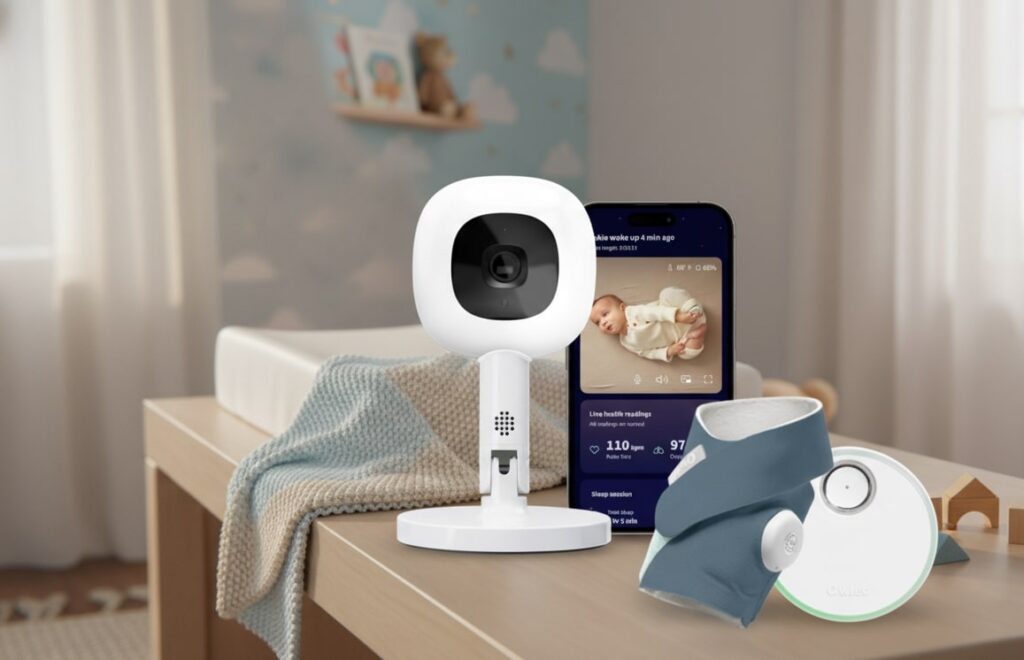
If your primary fear is SIDS (Sudden Infant Death Syndrome) or a health issue, the Owlet is in a league of its own. It doesn’t just watch your baby; it monitors them.
- Detailed Pros (Where the Peace of Mind Comes From):
- Active Vitals Monitoring: This is everything. Your baby wears a “Smart Sock” (a soft fabric bootie) that actively tracks their live heart rate and blood oxygen level (SpO2).
- The Base Station Alarm: This is the key. If your baby’s readings fall outside the preset safe zones, it doesn’t just send a notification to your phone (which might be on silent). It triggers a loud alarm from a physical Base Station in your room. Many parents on social media have harrowing, emotional stories of the Owlet alerting them when their baby was sick, choking, or had respiratory issues.
- A “Dose” of Reassurance: For parents of preemies, babies with RSV, or any parent with high anxiety, seeing those “green” vital readings on the app is like a medicine. It is the only product on this list that moves from passive watching to active health alerting.
- The Realistic Cons :
- THE. FALSE. ALARMS. This is the dark side of Owlet and the single biggest complaint. A sock that’s poorly placed, has a low battery, or gets kicked off by the baby can trigger a “Red Alert” at 2 AM. This sends parents leaping out of bed in a sheer panic, heart pounding, only to find the baby is perfectly fine. It can create anxiety instead of curing it.
- It is staggeringly expensive.
- The sock is another “thing” to manage: it needs to be charged daily, washed, and rotated between feet.
4. Eufy SpaceView Pro: The “No-Frills, All-Battery” Champion
Category: Non-Wi-Fi (Best for Battery Life & Simplicity)
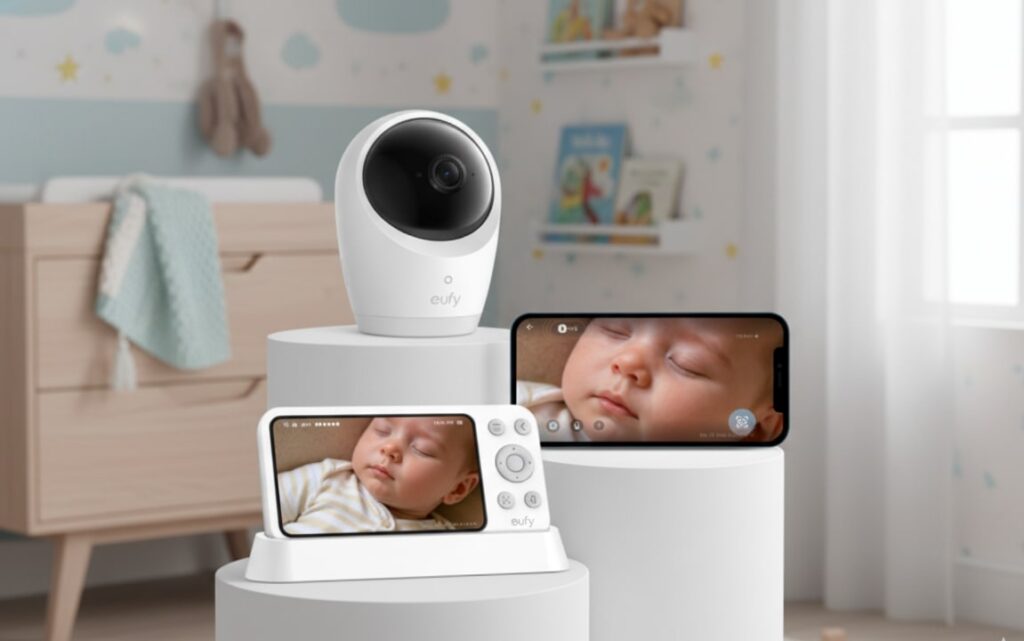
Think of the Eufy SpaceView Pro as the modern competitor to the Infant Optics. It takes the same “Non-Wi-Fi, Security-First” promise and adds a massive screen and a battery that simply refuses to die.
- Detailed Pros (Where the Peace of Mind Comes From):
- Legendary Battery Life: This is its superpower. We aren’t talking 8 hours. We’re talking 15, 20, or even 30 hours of active monitoring on a single charge (depending on the model/settings). You can carry the parent unit around the house all day, and often all night, without ever plugging it in.
- A Big, Crisp 5-inch 720p Screen: For a non-Wi-Fi unit, this screen is fantastic. It’s significantly larger and clearer than the base Infant Optics model, making it easy to see details from your nightstand.
- Set It and Forget It: Like the DXR-8 Pro, this is the definition of simplicity. No app to download. No Wi-Fi password to enter. No subscription fees, ever. You buy it, you plug it in, it works. The end.
- The Realistic Cons :
- The most common long-term complaint is the durability of the micro-USB charging port on the parent unit. After a year or two of nightly plugging and unplugging, it can become loose or fail.
- The range is great, but it’s still non-Wi-Fi. Don’t expect to be gardening in the far backyard.
5. Cubo Ai Plus: The AI Guardian Angel
Category: Wi-Fi (Best for AI Safety Alerts)
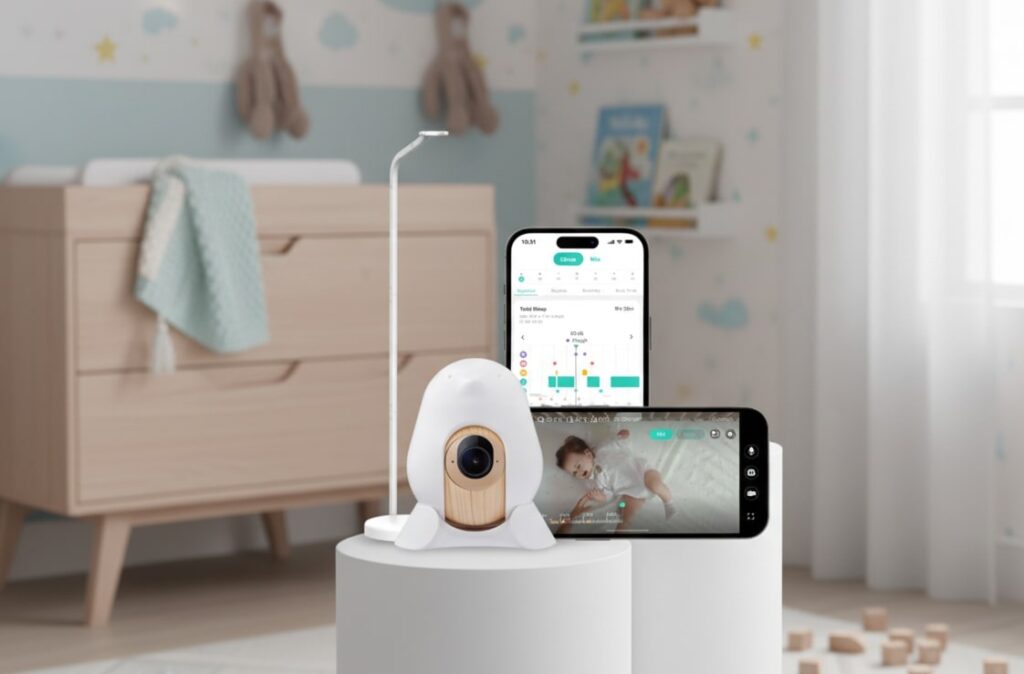
If your specific anxiety isn’t just about breathing, but about situations—like the baby rolling over or pulling a blanket over their face—the Cubo Ai is the watchful guardian you’re looking for.
- Detailed Pros (Where the Peace of Mind Comes From):
- Proactive AI Safety Alerts: This is its unique selling point. It uses AI to actively detect danger. Its key alerts are:
- Covered Face & Rollover Detection: If it detects your baby has rolled onto their stomach or that their face is obscured by a blanket, it sends an immediate alert. This is a game-changer for new parents in the “SIDS risk” phase.
- Danger Zone Alerts: When your baby becomes a toddler, this feature is amazing. You can draw a virtual “fence” on the app (e.g., the edge of the crib or the doorway). If your little escape artist crosses it, you’re alerted.
- Auto Photo/Video Capture: It’s smart enough to recognize “cute” moments—a smile, a big stretch, a yawn—and automatically capture them for you. It’s a delightful bonus.
- Cute Design: The little bird design is adorable and blends into a modern nursery aesthetic.
- Proactive AI Safety Alerts: This is its unique selling point. It uses AI to actively detect danger. Its key alerts are:
- The Realistic Cons :
- “Notification Spam.” The AI can be too sensitive. A parent’s hand entering the crib to pat the baby can trigger a “Covered Face” alert. A change in lighting can trigger a motion alert. Many parents report having to constantly fine-tune the sensitivity to avoid being spammed.
- The Subscription Model: Yes, just like Nanit. The best AI features and video storage are locked behind a monthly paywall after the first year.
The Final Verdict: Your Gut is the Best Monitor
There is no single “best” baby monitor, because every parent’s anxiety is unique.
The best monitor is the one that allows you to finally, deeply, exhale. It’s the one that quiets the “What if?” voices in your head.
To find your winner, just answer this:
- If you fear hackers and Wi-Fi failure most: Your choice is simple. Get the Infant Optics DXR-8 Pro or the Eufy SpaceView Pro.
- If you are a working parent who needs data and loves tech: Your choice is the Nanit Pro.
- If your anxiety is 100% focused on health and breathing: Your choice is the Owlet Dream Duo 2.
- If you fear situational dangers like rolling and suffocation: Your choice is the Cubo Ai Plus.
Choose the monitor that gives you permission to sleep.
You’ve got this.
FAQs
The best monitor depends on your needs. The Infant Optics DXR-8 Pro is best for non-Wi-Fi security, while the Nanit Pro is best for Wi-Fi features and sleep tracking.
Wi-Fi monitors carry a risk but can be secured. Always use a strong, unique password for your account and router, and enable two-factor authentication (2FA) if offered.
Most parents do not *need* one. However, vitals monitors (like Owlet) can provide significant peace of mind for anxious new parents or for babies with specific health concerns.
The main benefit is 100% privacy. Because it is not connected to the internet, it is impossible to hack remotely. It also provides a zero-lag, dedicated video feed.
For many parents, yes. The subscription unlocks valuable sleep analytics, video history, and AI-powered alerts (like rollover detection) that basic monitors do not offer.